web analytics

Commodore PET

The first entry to the markets by Commodore

The late 1970s marked the dawn of the home computer revolution, with 1977 often remembered as the “trinity year” of personal computing. In that year, three machines—the Apple II, the Tandy/Radio Shack TRS-80, and the Commodore PET—were launched, defining the early landscape of microcomputing. Among these, the Commodore PET (Personal Electronic Transactor) was Commodore’s entry into the rapidly growing market and became a pioneering system that bridged the gap between hobbyist electronics and business-ready personal computers.The Commodore PET was officially introduced at the Winter Consumer Electronics Show in January 1977, with shipments beginning later that year. It was the first fully integrated personal computer from Commodore, a company that had previously made calculators and electronic typewriters.

The PET combined a monitor, keyboard, and cassette tape drive in a single case—a novel design at the time that contrasted with the modular approach of early competitors. The 1977 market was in flux. Before the “trinity,” personal computers such as the Altair 8800 (1975) and IMSAI 8080 were available but were mainly kit-based systems for hobbyists. By contrast, the PET, the TRS-80, and the Apple II were complete, consumer-ready systems. Each offered a different vision: Apple focused on expandability and graphics, Tandy emphasized affordability and widespread retail availability, and Commodore targeted schools and businesses with an all-in-one design.

The original PET 2001 shipped with 4 KB or 8 KB of RAM, a built-in monochrome display, and a built-in cassette deck for data storage. It was powered by the MOS Technology 6502 microprocessor, running at 1 MHz. The PET’s design emphasized simplicity and robustness, which made it especially appealing for educational markets. The “chiclet” keyboard of the first models was criticized for being small and awkward, but later revisions introduced full-sized keyboards.

The PET ran Commodore BASIC, developed by Microsoft, which gave it compatibility with a wide range of early software written in BASIC. It lacked color graphics and had limited sound, which positioned it more as a practical computer than an entertainment device, though it nevertheless became a platform for early video games. The Commodore PET was especially successful in North America and Canada, where it penetrated schools and small businesses. Its durability and integrated design made it attractive for classrooms, as fewer components could break or be stolen. It also found adoption in the United Kingdom, particularly in schools before the BBC Micro and Sinclair ZX Spectrum rose to prominence.  Exact sales figures for the PET are difficult to confirm, but estimates suggest that between 200,000 and 300,000 units were sold worldwide during its lifespan from 1977 into the early 1980s. This figure was modest compared to the millions of Apple IIs and Commodore 64s that followed, but the PET’s importance lay in being Commodore’s first step into the personal computing world and in establishing its reputation in schools and businesses. The PET gave Commodore a foothold in the rapidly growing microcomputer industry and paved the way for its dominance in the 1980s with the VIC-20 and Commodore 64.

In Japan, however, the PET faced trademark issues that forced Commodore to market it under a different name: the Commodore CBM (Commodore Business Machine). The word “pet” was already trademarked by a local company for a line of small calculators, and Commodore avoided legal conflicts by rebranding. This “CBM” designation later carried over into European markets, where Commodore computers became widely known as CBM machines.

Reception

The PET was greeted with enthusiasm by much of the computing press in 1977–1978. Reviewers praised its integrated design, which contrasted sharply with the “kit” image of earlier personal computers. Magazines emphasized its “ready-to-use” nature, with Byte magazine noting that the PET was among the first computers that an average consumer could take out of the box and operate immediately. However, critics pointed out its shortcomings: the cramped chiclet keyboard, slow cassette drive, and lack of color graphics. Business publications questioned its utility as a serious business tool, given its limited memory and software, though many acknowledged its value for small enterprises and educational settings. Overall, the PET was seen as a forward-looking machine that hinted at the democratization of computing.

Although less prominent in popular culture than the Apple II or Commodore 64, the PET did leave its mark. Its distinctive, wedge-shaped all-in-one case often appears in documentaries and period films about the early computer age. In classrooms during the late 1970s and early 1980s, it became an iconic sight, often remembered by students as their first exposure to programming. The PET also influenced how computers were depicted in popular imagination: not as mysterious kits for hobbyists but as accessible, classroom-ready machines. In Canada and parts of Europe, it remains nostalgically recalled as the first computer used in school computer labs.

The significance of the PET can only be understood against the backdrop of the 1977 trinity. Apple, Tandy, and Commodore each staked a claim on the emerging personal computer market, and their different approaches shaped consumer expectations. Apple pursued expandability and eventually captured the creative market, Tandy capitalized on its vast retail network, and Commodore leveraged its manufacturing capabilities and cost control to deliver affordable, integrated systems. The PET stood out as a machine that was robust and educationally focused. Though less glamorous than the Apple II, it contributed substantially to normalizing the idea of having a computer in schools and small offices.

The Commodore PET, launched in 1977, was a milestone in the history of personal computing. As part of the landmark year alongside the Apple II and TRS-80, it offered an accessible, integrated design that helped bring computers into classrooms and small businesses. Its library of simple but engaging games, from Adventureland to countless BASIC clones of arcade hits, introduced users to interactive entertainment even on a system designed more for productivity. Its greatest popularity came in North America and Europe, though in those markets it was often branded as the Commodore CBM due to trademark issues. Selling a few hundred thousand units, it was not a runaway commercial success, but it established Commodore as a major player in computing and laid the foundation for later triumphs. Press reception was largely positive, recognizing the PET’s role in making computing accessible to ordinary users, though its limitations were clear. In popular culture, its distinctive shape and place in school computer labs gave it a lasting legacy as one of the earliest “friendly” computers. The PET may not have been the best-selling member of the 1977 trinity, but it was essential in legitimizing the concept of personal computing. It transformed Commodore into a serious competitor and remains a symbol of the bold experimentation that characterized the first wave of home computers.


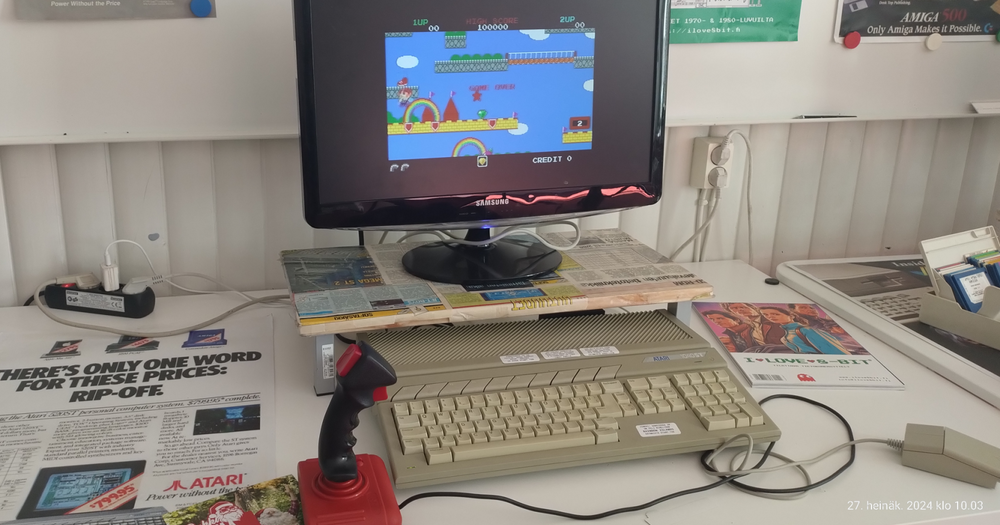
Commodore PET 8032 -tietokone. Kuva otettu Kokkolan I love 8-bit -tapahtumassa kaupunginkirjastossa. Näyttely oli avoinna 21.8-2.9.2023.

Commodore 128 – The jack of all trades

Released in 1985, the Commodore 128 represented one of the most ambitious attempts by Commodore International to create a truly versatile home computer. Dubbed by enthusiasts as the “multi-talented” machine, the C128 was designed to appeal to both the loyal Commodore 64 user base and new customers seeking a more powerful, flexible system. It was a triple-mode computer, capable of operating in C128 mode, C64 mode, and CP/M mode, making it remarkably adaptable for its era. This versatility made the C128 a unique proposition: a single machine that could serve as a home computer, a gaming platform, and a productivity tool for both students and professionals. At the heart of the C128 was a MOS Technology 8502 CPU running at 2 MHz in C128 mode, offering improved performance over the original 6510 in the C64. With 128 KB of RAM, dual disk drive support, and an expanded keyboard with numeric keypad and function keys, the system provided a substantial upgrade in both power and usability. Graphics were handled by the familiar VIC-II chip in C64 mode and VDC chip in native C128 mode, enabling high-resolution 80-column displays suitable for word processing, spreadsheets, and other productivity applications. The machine also retained backward compatibility with the vast Commodore 64 software library, a key feature that ensured a seamless transition for existing users.

One of the most significant innovations of the Commodore 128 was its CP/M mode, which allowed access to a wide range of professional and business software. CP/M, or Control Program for Microcomputers, was a widely used operating system for small business applications in the early 1980s, and its inclusion on the C128 opened the door to word processing, database management, and other productivity tools previously unavailable on most home computers. This dual appeal—home entertainment and business functionality—positioned the C128 as a multi-purpose platform, capable of serving multiple roles without requiring users to own separate machines.

Gaming remained a key focus of the C128, though most titles were played in C64 mode due to the extensive existing library. From platformers and adventure games to strategy titles, the C128 maintained full backward compatibility with C64 software, ensuring that gamers did not lose access to popular titles while also providing additional hardware capabilities for newer software. In native C128 mode, the machine offered improved text modes, 80-column display, and additional memory, which some developers exploited for productivity software and advanced programming projects. The Commodore 128 also made educational and professional computing more accessible. Schools and home users benefited from its expanded RAM, built-in BASIC 7.0, and ability to run both educational software and business applications. With its numeric keypad, improved keyboard, and higher-resolution display, the C128 was well-suited for spreadsheet programs, word processors, and even simple desktop publishing. Its flexibility made it a practical solution for families seeking a computer capable of entertainment, learning, and productivity—all in one machine.

Despite its many strengths, the C128 faced some challenges. Its complex triple-mode architecture could be confusing to novice users, who often did not understand the differences between C64 mode, C128 mode, and CP/M mode. Graphics and sound in native C128 mode were somewhat limited compared to the C64, meaning most gaming relied on backward compatibility. Additionally, while CP/M compatibility was innovative, it required an external disk drive and software setup that was not always intuitive, limiting its appeal to the average home user. Finally, the machine arrived at a time when the 8-bit era was nearing its end, and IBM PCs and Apple Macintosh computers were becoming increasingly accessible, providing stiff competition for professional and educational users. Nevertheless, the Commodore 128’s versatility earned it respect among enthusiasts. Its ability to serve as a home computer, a gaming system, and a professional platform in one package made it a unique offering in the 8-bit era. For hobbyists, programmers, and small business users, the C128 demonstrated that a single machine could perform multiple roles effectively. Its robust design, expanded memory, and backward compatibility ensured that it remained relevant even as the market transitioned to 16-bit and IBM-compatible systems. Culturally, the Commodore 128 exemplified the flexibility and ingenuity of the 1980s home computing era. It allowed users to explore programming, enjoy gaming, and perform productivity tasks on the same machine, encouraging experimentation and creativity. Though it never surpassed the commercial success of the original Commodore 64, its legacy endures as a symbol of adaptability and ambition in personal computing. Retro enthusiasts continue to celebrate the C128 for its multi-talented design, preserving both hardware and software for posterity. It remains a testament to a time when home computers were evolving rapidly, and the idea of a single, versatile machine capable of meeting multiple needs was still a revolutionary concept.

In conclusion, the Commodore 128 stands as one of the most versatile 8-bit home computers ever produced. Its triple-mode architecture, backward compatibility, CP/M support, and expanded capabilities made it a multi-purpose tool for gaming, education, and productivity. While its complexity and market timing limited widespread dominance, it showcased the potential of flexible, multi-role computing. The C128’s ability to do “many things at once” cemented its place as a unique and influential system, demonstrating that innovation in design and functionality can leave a lasting mark, even if commercial success is limited.


Spectravideo SVI-728

Leading the MSX Revolution:
The Story of the Spectravideo SVI-728

In the early 1980s, the home computer revolution was sweeping across the globe. Japan had the MSX standard, the United States had Commodore and Apple, and Europe was embracing a variety of homegrown machines. One of the less-known but technically interesting participants in this era was Spectravideo, an American company that combined ambition with innovation to produce the SVI-728, a home computer released in 1984. While it never achieved the fame of a Commodore 64 or ZX Spectrum, the SVI-728 represents a fascinating chapter in 8-bit computing and found a modest audience even in countries like Finland.

Spectravideo had its roots in peripherals and computer accessories but quickly moved into full system design. The SVI-728 was the follow-up to their earlier SVI-318 and SVI-328 models and conformed to the MSX standard, which was a key selling point. Being MSX-compatible meant that the SVI-728 could run a broad library of software and games, an attractive feature for buyers in smaller markets where software availability was otherwise limited. In the early 1980s, the MSX standard promised compatibility and a certain global uniformity: a game developed in Japan could, in theory, run on a Finnish SVI-728 just as it would on a Spectravideo in the United States.

Spectravideo SVI-728 in operation at the I love 8-bit® exbitition 2023

In the early 1980s, the home computer revolution was sweeping across the globe. Japan had the MSX standard, the United States had Commodore and Apple, and Europe was embracing a variety of homegrown machines. One of the less-known but technically interesting participants in this era was Spectravideo, an American company that combined ambition with innovation to produce the SVI-728, a home computer released in 1984. While it never achieved the fame of a Commodore 64 or ZX Spectrum, the SVI-728 represents a fascinating chapter in 8-bit computing and found a modest audience even in countries like Finland.

Spectravideo had its roots in peripherals and computer accessories but quickly moved into full system design. The SVI-728 was the follow-up to their earlier SVI-318 and SVI-328 models and conformed to the MSX standard, which was a key selling point. Being MSX-compatible meant that the SVI-728 could run a broad library of software and games, an attractive feature for buyers in smaller markets where software availability was otherwise limited. In the early 1980s, the MSX standard promised compatibility and a certain global uniformity: a game developed in Japan could, in theory, run on a Finnish SVI-728 just as it would on a Spectravideo in the United States.

Technically, the SVI-728 was a capable machine. It featured a Zilog Z80A processor at 3.58 MHz and 64 KB of RAM, which allowed it to handle most home and educational programs of the era. Graphics were handled by a TMS9918 video processor, capable of displaying 16 colors and up to 32 sprites on screen, while sound came from the AY-3-8910 chip, providing three channels of tone and one for noise. This made the system suitable not only for games but also for basic music composition and educational software. Its built-in MSX BASIC interpreter allowed hobbyists and young programmers to write their own programs immediately after switching on the machine, reflecting the era’s spirit of experimentation and learning.

Design-wise, the SVI-728 was compact and functional, featuring a full-sized keyboard and cartridge slot. Unlike some of the cheaper rubber-keyboard systems, it was built with quality in mind, though it lacked the flashy styling that characterized some of its competitors. Expansion ports allowed connection to printers, disk drives, and joysticks, making it versatile for both home and educational use. In Finland, where computers were often seen as tools for both play and study, the SVI-728 found a niche. Finnish computer magazines of the mid-1980s occasionally covered the machine, noting its solid design and compatibility with MSX software, which allowed Finnish users access to a library of educational titles and games that might otherwise have been unavailable locally.

Despite its technical strengths, the SVI-728 faced significant challenges. The MSX standard was strong in Japan and parts of Europe, but in the United States, Commodore and Atari dominated the market. In Finland, the home computer scene in 1984–1985 was dominated by machines such as the Commodore 64, Sinclair ZX Spectrum, and later Amstrad CPC models. The SVI-728’s MSX compatibility gave it a technical advantage, but software availability and local retail support were limited, making it a harder sell to families and hobbyists. For enthusiasts and collectors, however, the SVI-728 offered a robust MSX-compatible platform with a clear design and respectable hardware. In practice, the buyers who acquired the SVI-728 often appreciated it for educational and hobbyist purposes. Schools and computer clubs could use its BASIC environment to teach programming, while children and teenagers enjoyed games like Knightmare, Penguin Adventure, and other MSX titles. Its audio and graphics capabilities allowed for creative projects, including simple music compositions and sprite-based animations, bridging the gap between entertainment and learning. For many users, the SVI-728 represented a “serious” computer in a small, versatile package, offering functionality that felt sophisticated compared to budget alternatives.

The SVI-728’s commercial lifespan was relatively short. Spectravideo continued producing and supporting MSX-compatible machines through the mid-1980s, but it could not compete with the volume sales of Commodore or the marketing power of Nintendo in the gaming sector. Production gradually ceased toward the late 1980s as newer MSX2 machines and other 16-bit computers began to dominate the market. Yet even decades later, the SVI-728 remains a favorite among retro-computing enthusiasts, especially in Europe. Collectors in Finland and neighboring countries often seek out the machine for its solid build, compatibility, and the nostalgia it evokes for an era when home computing was new, experimental, and exciting. Ultimately, the Spectravideo SVI-728 exemplifies a particular moment in computing history: a time when the MSX standard promised global compatibility, when computers were both tools and toys, and when even smaller players could make technically capable machines with a lasting legacy. In Finland, as elsewhere, it served as a bridge between education, gaming, and early programming exploration. While it never reached the fame of its contemporaries, it remains a symbol of the creativity, ambition, and optimism of the mid-1980s home-computer era. For those who experienced it, the SVI-728 was more than just hardware; it was an introduction to a world of digital possibility.

Dragon 32

A Welsh Chapter in Home Computing History

British households, once dominated by typewriters and telephones, were suddenly discovering the wonders of microchips and keyboards. It was into this arena that the Dragon 32 and its successor, the Dragon 64, made their entrance. Developed by Dragon Data Ltd of Port Talbot, Wales, these machines briefly shone as symbols of British ambition in a global race dominated by giants such as Commodore, Sinclair, and Apple. The Dragon computers owed their existence to a mix of timing and circumstance. The parent company, Mettoy, was better known for manufacturing toys, but like many businesses in the early 1980s, it saw computing as a sector ripe for expansion. With financial support and technical collaboration, the Dragon 32 was brought to market in August 1982. At its heart was the Motorola MC6809E processor, widely regarded as one of the most advanced 8-bit CPUs of the time. This made the Dragon a close cousin of the American TRS-80 Color Computer (CoCo), which shared the same architecture. For the United Kingdom, however, the Dragon 32 represented a domestically-produced alternative to the foreign imports flooding the market.

On first impressions, the Dragon 32 seemed solid—literally and figuratively. Its plastic case was sturdy, its keyboard was of higher quality than the “dead-flesh” keys of the ZX Spectrum, and its Microsoft Extended BASIC gave budding programmers a flexible tool with which to learn their craft. The processor, though clocked at a modest 0.89 MHz, was powerful in terms of instruction set design, appealing to serious hobbyists who wanted to push the boundaries of 8-bit computing. For families and schools, the Dragon was marketed not only as a gaming device but as an educational tool. It was also priced competitively: around £175 at launch, making it affordable compared to the BBC Micro but more expensive than the Spectrum.

The markets

The Dragon 32 was soon followed by the Dragon 64, released in 1983. As the name implied, it doubled the available RAM to 64 KB, allowing users to run more demanding applications. The Dragon 64 also introduced a built-in RS-232 serial interface, making it better suited to business and communications tasks such as connecting to modems or terminals. Both machines supported expansion through cassette recorders, floppy disk drives, printers, and joysticks, with a modest ecosystem of peripherals emerging during their lifespan. Although the Dragon line was not designed primarily as a gaming machine, games inevitably became a crucial part of its appeal. Much of the software library consisted of ports or clones, many of them adapted from the TRS-80 Color Computer. Popular titles included Cuthbert Goes Walkabout, Cuthbert in Space, and Time Bandit, all of which became emblematic of the platform. Still, the Dragon lagged behind competitors in this arena. Its graphics resolution and sound hardware could not compete with the colorful output of the Commodore 64 or the playful charm of the ZX Spectrum, and this limited its attractiveness to the teenage gamers who drove much of the market.

The press and Dragon computers

The British computing press was respectful but not enamored. Reviewers praised the Dragon’s sturdy construction, serious programming environment, and the power of the 6809 processor. Yet the tone of coverage often suggested that the machine lacked glamour. Where the Spectrum dazzled with cheap thrills and the Commodore 64 impressed with arcade-quality games, the Dragon was seen as workmanlike. For education and hobbyist programming it had clear merits, but as a general-purpose home entertainment device, it struggled to inspire excitement.

The fall and legacy

Despite early enthusiasm and a respectable foothold in the UK market, Dragon Data quickly found itself in trouble. The market was crowded, and price wars left little room for a mid-range machine that was neither the cheapest nor the most entertaining. By 1984, financial problems became insurmountable, and Dragon Data entered receivership. Its assets were acquired by the Spanish company Eurohard S.A., which attempted to continue production and distribution in Spain and parts of Europe, but the momentum had already been lost. Within a few years, the Dragon computers faded quietly from the market. The Dragon 32 and 64 are remembered as bold, if short-lived, attempts to carve out a place in the golden age of home computing. They offered sturdiness, sophistication, and an unusually powerful CPU for the time, but in an industry driven by price, graphics, and mass-market software, these strengths were not enough. Collectors and retro enthusiasts now regard the Dragon machines as quirky relics of a fascinating era—a Welsh voice in a global conversation that was quickly drowned out by larger, louder competitors.

Sega Megadrive

Sonic and the 16-Bit Era:

The Story of the Sega Mega Drive/Genesis

In the late 1980s, the video game world stood at the edge of a new era. The 8-bit consoles that had revived the industry earlier in the decade were beginning to show their age, and a generation raised on simple sprites and chiptunes was ready for something faster, louder, and more dramatic. Into this moment stepped Sega, a company already known for its boldness and technical prowess. Its new console — called the Mega Drive in Japan and Europe, and the Genesis in North America — would not only change the company’s destiny but also ignite one of the most famous rivalries in entertainment history.

Sega’s story before the Mega Drive was one of near-success and frustration. The company’s previous home console, the Sega Master System, had been technically impressive but commercially overshadowed by Nintendo’s NES. Sega had learned a hard lesson: power alone wasn’t enough to win the market. When development of a new 16-bit console began in 1987, Sega’s engineers wanted to make something that not only outperformed Nintendo’s aging hardware but also captured the spirit of the arcade machines that had made Sega famous. The goal was simple: bring the arcade home.

Released in Japan in October 1988, the Mega Drive was powered by a Motorola 68000 processor running at 7.6 MHz, supported by a Zilog Z80 that handled sound and backward compatibility. It featured 64 colours on screen from a palette of 512, and sound produced by a Yamaha FM synthesizer chip — the same kind of rich, expressive tone generator used in Sega’s arcade cabinets. Compared to 8-bit machines, it was a revelation: smoother scrolling, larger sprites, and music that felt alive. Sega marketed it as a “true 16-bit” experience, and for once, the slogan wasn’t an exaggeration.

But the Japanese launch was only a modest success. Nintendo’s Famicom still dominated the domestic market, and NEC’s PC Engine had captured the attention of early adopters. Sega knew that to survive, it needed to look beyond Japan. In 1989, the company launched the console in North America under a new name: the Sega Genesis. The rebranding was deliberate — bold, forward-looking, and distinctly American. Sega of America’s marketing team, led by the legendary Tom Kalinske, crafted a campaign that would define the decade: “Genesis does what Nintendon’t.”

The slogan captured the essence of Sega’s new identity — rebellious, energetic, and slightly irreverent. Where Nintendo projected family-friendly wholesomeness, Sega positioned itself as the cooler, edgier alternative for teenagers. Its advertising was loud and fast, filled with neon lightning bolts and pounding rock music. Sega wasn’t selling just a console; it was selling an attitude. This strategy worked brilliantly. The Genesis became the console of choice for a generation that wanted to grow up from Mario’s cheerful worlds into something faster and sharper.

The Mega Drive’s library quickly reflected that new identity. Early titles such as Golden Axe, Ghouls ’n Ghosts, and Altered Beast showed off its arcade heritage, while Streets of Rage and Shinobi established Sega’s reputation for action and style. Yet the true turning point came in 1991, when Sega introduced a blue hedgehog with red shoes — Sonic the Hedgehog. Designed specifically to challenge Nintendo’s mascot, Sonic was speed, attitude, and energy personified. His world zipped by at breathtaking speed, his music pulsed with FM synth rhythms, and his design appealed to the exact demographic Sega was courting. Sonic wasn’t just a game; he was a manifesto.

The success of Sonic the Hedgehog transformed Sega’s fortunes. By 1992, the Genesis had overtaken Nintendo’s Super NES in the U.S. market, a feat few would have thought possible. Sega’s market share soared, reaching over 60% at its peak. For the first time since the early 1980s, Nintendo was no longer untouchable. Sega had created not just a successful console, but a cultural movement — the “Genesis generation.”

At its best, the Mega Drive represented the perfect fusion of hardware and imagination. Developers learned to use its strengths — the fast CPU, the FM sound chip, and the crisp sprite handling — to create experiences that felt truly cinematic for their time. Games like Gunstar Heroes, Phantasy Star IV, Ecco the Dolphin, and ToeJam & Earl demonstrated a remarkable variety of tone and vision. Sports fans embraced Madden NFL and NHL ’94, both of which ran smoother on Sega’s hardware than on Nintendo’s. The system’s sound chip, in particular, gave it a distinctive identity: gritty, powerful, unmistakably “Sega.”

The Mega Drive’s success was not universal, however. In Japan, it remained a niche product, never coming close to the dominance of the Famicom or Super Famicom. In North America, its fortunes began to wane by the mid-1990s, as new competitors entered the field. Yet in Europe and South America, especially Brazil, the Mega Drive became a legend. Distributed once again by TecToy in Brazil, it continued to sell for decades — and is still produced in updated forms today. In Europe, its sleek design and wide range of arcade conversions made it the defining console of the early 1990s. For many European gamers, the sound of the Sega logo boot-up jingle is as iconic as any pop song from the decade.

Sega’s rivalry with Nintendo during this period became the stuff of myth. It was a clash not only of products but of philosophies: discipline versus defiance, family versus freedom. Each company pushed the other to innovate. Sega’s aggressive marketing forced Nintendo to loosen its strict licensing rules, while Nintendo’s high-quality software standards pushed Sega’s developers to aim higher. The “console war” was fought in magazine ads, TV commercials, and schoolyards around the world, but in truth, it benefited gamers everywhere. The competition created some of the most memorable games and characters in history.

As the 1990s progressed, however, the winds began to change. The rise of CD-ROM technology and 3D graphics signaled that the 16-bit era was ending. Sega launched the Mega-CD (known as the Sega CD in America) and the 32X add-on in attempts to extend the Mega Drive’s life, but both were commercial missteps — confusing for consumers and expensive to produce. When the Sega Saturn arrived in 1994, the company’s focus shifted entirely to the 32-bit generation. The Mega Drive quietly faded from store shelves, but by then, it had sold more than 35 million units worldwide, securing its place among the most successful consoles ever made.

Looking back, the Mega Drive was more than just a machine; it was a statement. It proved that Sega could stand toe-to-toe with Nintendo, that style and attitude could be as powerful as hardware specs. It captured the energy of the early 1990s — a mix of neon optimism and rebellious cool — and turned it into a gaming identity. Even today, its games retain a kind of raw, kinetic charm. The FM soundtracks still thrum with life; the pixel art still feels bold and confident.

The legacy of the Sega Mega Drive endures not only through nostalgia but through influence. Modern indie developers often cite its design principles — speed, clarity, rhythm — as inspiration. Its best games remain benchmarks of how to balance challenge and playability. And its rivalry with Nintendo set the stage for everything that followed: Sony versus Microsoft, PlayStation versus Xbox — all echoes of that first, furious battle for hearts and minds.

When you switch on a Mega Drive today and hear the sharp burst of its startup chime, you’re reminded of an age when video games were not yet global corporate empires but wild experiments in imagination. Sega’s 16-bit console was born from ambition, thrived on competition, and faded with dignity. It was the machine that dared to shout while others played safe — and in doing so, it gave an entire generation its soundtrack of speed.

Canon V20

A Quiet Classic:

The Canon V-20 and the Beauty of Simplicity

In the early 1980s, Japan’s electronics industry was experiencing a period of explosive creativity. The home computer boom that had begun in Britain and America was spreading across Asia, and Japanese manufacturers — Sony, Panasonic, Yamaha, Toshiba, and Canon among them — saw an opportunity to standardize and globalize the personal computer. The result of this effort was the MSX standard, announced in 1983: a shared architecture intended to unify the fragmented 8-bit computer market under one banner. Within this ecosystem, the Canon V-20, launched in 1984, represented Canon’s entry into the race — a machine that reflected both the ambitions and the limitations of the MSX dream. Canon was already a respected name in technology, best known for its cameras and office equipment. In joining the MSX initiative, the company sought to extend that reputation into the rapidly growing world of personal computing. The Canon V-20 was built to conform precisely to the MSX specification, which made it compatible with any MSX software or peripheral, regardless of manufacturer. This was the genius of the standard: an MSX program written for a Sony or Yamaha computer would also run on Canon’s, giving users a broad and stable software ecosystem. For a brief moment, it seemed like the future of home computing.

The Canon V-20 was a sleek, compact machine typical of Japanese design aesthetics at the time. Inside, it ran on a Zilog Z80A processor at 3.58 MHz and included 64 KB of RAM — enough to run most MSX programs and games. It featured a Texas Instruments TMS9918A video display processor capable of 16 colours and hardware sprites, and sound came from the General Instrument AY-3-8910 chip, offering three channels of tone and one of noise. In practice, this meant colourful graphics and pleasant, if simple, music — roughly on par with the popular home computers of the time such as the Commodore 64 and the Amstrad CPC.

The machine used Microsoft Extended BASIC, a version of BASIC specifically designed for the MSX standard. For hobbyists and young programmers, this language made the Canon V-20 a gateway into coding: with just a few lines, one could draw shapes, animate sprites, or compose sound effects. The computer booted directly into the BASIC environment, inviting users to experiment and learn — a hallmark of the home-computing era. The V-20 was also compatible with cartridge-based games, which made it appealing to children and families who wanted both play and productivity in a single machine. Design-wise, the V-20 was elegant. Its keyboard was full-sized and responsive, its layout clear and professional. Canon offered the machine in a tasteful silver-grey case with a minimalistic aesthetic, consistent with the brand’s style in its cameras and calculators. It was also relatively affordable, selling for around ¥49,800 in Japan — a price that placed it within reach of home users while maintaining an air of quality. Despite these strengths, the Canon V-20 was not a revolutionary computer. It was, like most MSX machines, a carefully built expression of a shared standard rather than a unique creation. In this sense, its individuality was limited: Canon’s implementation differed little from that of Sony, Toshiba, or Sanyo. Its real distinction came from the Canon name — a symbol of reliability — rather than from technical innovation.

When it reached Europe, the V-20 was marketed as a stylish and dependable alternative to other MSX systems. In the Netherlands and Spain, where the MSX format gained some popularity, Canon’s model was well received by enthusiasts. Reviewers appreciated its solid keyboard and attractive design, though they noted that its feature set was nearly identical to that of its competitors. For software, users could choose from a growing library of MSX titles, including games such as Knightmare, Penguin Adventure, and Metal Gear, as well as educational and productivity software. However, by 1985, the international computer market had shifted dramatically. In North America and Western Europe, the MSX format struggled to gain traction against established brands like Commodore and Sinclair. Canon, despite its prestige, lacked the kind of distribution network and marketing power that might have made the V-20 a household name outside Japan. Meanwhile, in Japan itself, the MSX standard was already evolving toward more powerful second-generation models, such as the MSX2, which offered improved graphics and memory. The V-20 quickly became outdated, and Canon soon withdrew from the computer market entirely to refocus on its core imaging business.

Yet the Canon V-20 remains a fascinating artifact of its time. It embodies a rare moment when dozens of competing manufacturers worked together toward a shared technological goal — something almost unimaginable in today’s proprietary world. It also represents Canon’s brief but earnest attempt to become a player in personal computing. For those who owned one, the V-20 offered a balanced combination of functionality and refinement: a machine that could serve as both a child’s first computer and a parent’s typing tool. In retrospect, the Canon V-20’s significance lies not in its sales figures, which were modest, but in its participation in the MSX experiment itself. That experiment succeeded in Japan, South America, and parts of Europe, even if it failed to conquer the United States. The V-20 thus stands as a symbol of a global idea — the idea that computers could share a common language across brands and borders.

Today, the Canon V-20 is cherished by collectors for its design, reliability, and place in MSX history. When powered on, its blue MSX BASIC screen still appears with that familiar prompt:

MSX
BASIC version 1.0

Copyright
1983 by Microsoft.

For a brief moment, one can imagine the optimism of 1984 — a time when Canon, Sony, and Yamaha believed that the future of personal computing could be standardized, simple, and beautiful.

Sega Master System

The forgotten 8-Bit Hero:

Sega Master System Shaped a Generation

In the mid-1980s, the video game industry was still reeling from its first great crash. The early years of home gaming — dominated by Atari, Mattel, and Coleco — had ended in oversaturation and consumer fatigue. Many believed that home consoles had peaked. Yet across the Pacific, Japan’s electronics companies saw a different future: a new generation of consoles that combined arcade-quality graphics with affordable home entertainment. Among these companies was Sega, a firm already famous for its coin-operated arcade machines. Its response to the changing times would be the Sega Master System, a console that never quite won the global race, but which left an indelible mark on gaming history.

Sega’s console lineage began with the SG-1000, released in Japan in 1983 — the very same day Nintendo launched its Famicom. The SG-1000 and its successor, the SG-1000 Mark II, were promising but modest machines. Sega’s engineers, however, were determined to leap ahead technologically. In 1985, they unveiled the Sega Mark III, a sleek new system powered by an 8-bit Zilog Z80A processor running at 3.58 MHz. It offered far superior graphics and sound compared to its predecessors, and it was fully backward compatible with SG-1000 games. The Mark III impressed the Japanese market with its colour palette of 64 shades and a resolution of up to 256×192 pixels — features that put it technically on par, if not above, the Nintendo Famicom.


Sega Master System in operation at the I love 8-bit® -exhibition in Finland 2024.

When Sega prepared to enter the Western market, the company rebranded the Mark III as the Sega Master System. The new name, and the new design, reflected a clear intent to appeal to consumers outside Japan — particularly in North America and Europe. The system launched in Japan in October 1985, in North America in 1986, and in Europe and other territories in 1987. Its hardware was essentially identical to the Mark III, but it featured a more futuristic black-and-red casing and a redesigned cartridge format. Sega also introduced a smaller “Sega Card” format — thin credit card-sized game cartridges that could hold up to 32 kilobytes of data.

Technically, the Master System was an impressive piece of engineering for its time. Its graphics processor could display more colours and more on-screen sprites than the NES, and its sound chip — the Texas Instruments SN76489A — produced richer tones than Nintendo’s simpler audio hardware. Optional accessories expanded its capabilities further: a light gun called the Light Phaser and 3D glasses that worked surprisingly well with compatible titles such as Space Harrier 3D and Maze Hunter 3D. These technical achievements gave Sega a powerful marketing message: the Master System was the most advanced 8-bit console in the world.

However, technology alone could not guarantee success. When Sega entered the American market, Nintendo had already transformed the industry with its Nintendo Entertainment System (NES). The NES had not only revived gaming after the crash, but also built a vast ecosystem of exclusive software and loyal developers. Nintendo’s licensing policies effectively prevented most third-party companies from producing games for rival consoles. Sega thus found itself fighting with one arm tied behind its back: even though the Master System could outperform the NES on paper, it struggled to compete with Nintendo’s game library and market dominance.

To make matters worse, Sega’s American distributor, Tonka, lacked experience in the video game industry. Marketing was inconsistent, and distribution was limited. The Master System’s packaging and advertising often failed to capture the imagination of children in the way Nintendo’s did. As a result, in North America, the console never sold more than a few million units. Estimates suggest that by the early 1990s, total Master System sales in the U.S. were around 2 million, compared to more than 30 million NES units.

Yet the story of the Sega Master System was far from a failure — it simply unfolded differently depending on where one looked. In Europe, particularly in the United Kingdom, France, and Spain, Sega’s console found a welcoming audience. European players were less bound by Nintendo’s exclusivity agreements, and Sega partnered with local distributors such as Virgin Mastertronic, who marketed the console aggressively and effectively. The Master System became a household name across Europe, where it often outsold the NES. Its sharp visuals and fast-paced games appealed to European tastes, and its lower price compared to the later Mega Drive made it an enduring success well into the 1990s.

In Brazil, the Master System became a phenomenon. Through a partnership with TecToy, Sega localized the console, translated games into Portuguese, and even created original Brazilian exclusives. The Master System’s popularity in Brazil was so great that production continued there for decades — long after it had disappeared elsewhere. Even today, TecToy continues to release updated versions of the system, making the Master System arguably the most long-lived 8-bit console in history.

Critically, the Master System was admired for its craftsmanship and arcade-style design. Reviewers in the 1980s praised the console’s smooth scrolling graphics, clean audio, and futuristic styling. Its build quality was high, and its controllers — small rectangular pads with a simple D-pad and two buttons — were responsive and comfortable. The built-in game Hang-On or Snail Maze (depending on the model) ensured that every owner had something to play immediately. Sega also capitalized on its arcade heritage, bringing home versions of its coin-op hits such as Space Harrier, Out Run, and Shinobi. These titles showcased the Master System’s strengths and gave it a distinctive identity: fast, colourful, and slightly more mature than Nintendo’s cheerful world of plumbers and princesses.

Still, the console had its weaknesses. The game library, while respectable, never matched the sheer volume and variety of the NES. Many developers were tied to Nintendo contracts and could not release titles for Sega’s system. The Master System’s sound chip, while technically superior in some respects, lacked the warmth and musicality that characterized many NES soundtracks. In North America and Japan, where brand loyalty to Nintendo was strong, the Master System was often seen as the “other console” — technically impressive but lacking in magic.

Nevertheless, for players who owned one, the Master System delivered memorable experiences. Titles such as Alex Kidd in Miracle World, Phantasy Star, Wonder Boy III: The Dragon’s Trap, and R-Type became beloved classics. Phantasy Star in particular stood out as one of the most advanced role-playing games of its era, featuring 3D dungeons and a complex story long before such features were common. These games hinted at the creativity and ambition that would later define Sega’s 16-bit era.

In the end of 1980’s, Sega introduced the Mega Drive (known as the Genesis in North America), the Master System gradually faded from the spotlight. In Japan and the United States, it was discontinued by 1991, but in Europe and South America it persisted much longer. The Master System II, a smaller and cheaper redesign released in 1990, kept the brand alive for several more years. By the end of its life, global sales were estimated at over 13 million units — modest compared to Nintendo’s dominance, but enough to establish Sega as a formidable player in the console wars to come.

Looking back, the Sega Master System occupies a fascinating space in gaming history. It was both a success and a failure — a commercial underdog in some markets, a cultural icon in others. It proved that technology and design alone were not enough to win a console war; distribution, licensing, and software mattered just as much. Yet it also laid the foundation for Sega’s later triumphs. The Master System’s technical sophistication and arcade spirit foreshadowed the style and energy that would define the Sega Mega Drive/Genesis, and its influence can still be felt in Sega’s modern brand identity.

Today, the Master System is remembered with affection by collectors and retro-gaming enthusiasts. Its sharp, clean graphics, bright colour palette, and distinctive game library stand as a testament to an era when consoles were simpler but full of character. It reminds us that even the “second place” machines of history can have stories worth telling — stories of innovation, resilience, and regional success.

The Sega Master System may not have conquered the world, but in its own way, it changed it. It taught Sega how to compete globally, it brought joy to millions outside Japan and America, and it laid the groundwork for one of the most dynamic rivalries in entertainment history: Sega versus Nintendo. In that sense, its legacy is larger than its sales figures. It was the console that dared to challenge a giant — and in doing so, ensured that video gaming would never again be a one-company world.

Apple IIe

The Computer That Educated a Generation:
Apple IIe

In the late 1970s, the personal computer industry was still in its infancy, dominated by hobbyist kits and small-scale electronics. Into this landscape stepped Apple Computer, a young company founded by Steve Jobs and Steve Wozniak in 1976. Their first machine, the Apple I, was a modest kit sold primarily to enthusiasts, but it laid the foundation for something far more ambitious. The **Apple II series**, introduced in 1977, would become one of the most influential lines of personal computers in history. Among its iterations, the **Apple IIe**, released in 1983, stands out as a symbol of refinement and longevity, combining technical improvements, ease of use, and software compatibility to solidify Apple’s foothold in homes, schools, and small businesses.

Classic Apple Computers in operation at the I love 8-bit® exhibition

The Apple IIe, short for “enhanced,” represented a thoughtful evolution of the Apple II architecture. It retained the familiar 8-bit **MOS Technology 6502 processor** running at 1 MHz but increased memory capabilities and added new features. The base model shipped with **64 KB of RAM**, expandable to 128 KB, and a new **built-in ASCII keyboard** replaced the earlier mechanical-switch design, offering a more comfortable typing experience. One of its most significant enhancements was the addition of **full ASCII character set support** and the ability to display both upper- and lowercase letters, which greatly improved readability and usability for word processing and programming. Graphics and sound capabilities were consistent with the earlier Apple II family, but incremental improvements made software more visually appealing and versatile.

The Apple IIe excelled in versatility, reflecting Apple’s understanding that personal computing was not a single-purpose activity. The machine could run **educational software**, business programs like **VisiCalc** and **AppleWorks**, and a growing library of games. Its **eight expansion slots** allowed users to add disk drives, memory boards, modems, and even third-party peripherals such as printers and joysticks. This modularity was particularly important in educational settings. Schools across the United States, and eventually in Europe and even Finland, embraced the Apple IIe because it could serve multiple purposes: a learning tool for programming, a platform for science and math simulations, and a gaming machine that engaged students in a fun way.

In Finland, the Apple IIe carved a niche among hobbyists, educational institutions, and tech enthusiasts. Local distributors provided access to both hardware and software, although availability was more limited than in the United States. Finnish computer clubs often used the Apple IIe for programming workshops and early networking experiments. Its BASIC interpreter encouraged a generation of programmers to explore coding fundamentals, while programs like **Logo** and **Oregon Trail** introduced students to problem-solving and simulation in an accessible way. In this sense, the Apple IIe was not merely a machine; it was a gateway into computing literacy at a time when digital skills were increasingly valued.

The press generally praised the Apple IIe for its durability, expandability, and compatibility with the extensive Apple II software library. Reviewers highlighted the comfort of its keyboard, the clarity of its graphics, and the broad ecosystem of applications as major strengths. Criticisms were relatively minor: the machine’s sound capabilities were limited compared to contemporary gaming-oriented consoles, and its price was higher than some 8-bit competitors. Still, for those willing to invest in a professional-quality home computer, the Apple IIe offered unmatched flexibility and long-term support.

The broader Apple II series, of which the IIe was a pivotal member, had a remarkably long life span. It began with the original **Apple II in 1977**, which established Apple as a company capable of producing a polished, ready-to-use home computer. The **Apple II Plus** followed in 1979, increasing memory and supporting Applesoft BASIC in ROM. The Apple IIe enhanced this architecture in 1983, while later models, including the **Apple IIc** and **Apple IIGS**, introduced portability and improved graphics and sound. Despite the rise of the Macintosh in the mid-1980s, the Apple II line remained in production for educational and business markets well into the early 1990s. Apple officially discontinued the Apple II series in **1993**, marking the end of an era that had begun with a simple wooden-case computer in a Silicon Valley garage.

Looking back, the Apple IIe exemplifies the strengths of Apple’s early approach: a machine designed for both versatility and reliability, capable of evolving while remaining compatible with a rich software ecosystem. Its influence extended far beyond homes and schools; it inspired a generation of programmers, entrepreneurs, and engineers who would go on to shape the digital world. The Apple IIe was more than a piece of hardware — it was a cultural and technological milestone that helped define the possibilities of personal computing.

In summary, the Apple II series, beginning with the original 1977 Apple II and culminating with the IIe and its successors, represents a remarkable chapter in computing history. It began as a hobbyist’s dream, matured into a professional and educational tool, and ended as a foundational legacy for Apple’s future innovations. The Apple IIe, in particular, symbolizes this evolution: a machine that combined technical competence, usability, and longevity, ensuring that the lessons and experiences it provided would resonate long after its production ended.

Commodore 64G

Commodore 64G: Refining a Classic

By the mid-1980s, the Commodore 64 had already established itself as a powerhouse in the home computer market. Launched in 1982, it quickly became the best-selling single computer model of its era, admired for its combination of affordability, versatility, and technical capability. In 1987, Commodore introduced the C64G, a minor but notable update to the original design. While it retained the iconic 8-bit MOS 6510 processor, 64 KB of RAM, and the beloved SID sound chip, the C64G’s appeal lay in refinement rather than reinvention.

The most visible difference was the redesigned casing. Gone was the slanted beige body of earlier models, replaced by a sleeker, vertical-style case with a more modern feel. The C64G also featured minor improvements to the keyboard and internal components, making it easier to manufacture and slightly more reliable. To users, it looked familiar yet fresh — a Commodore 64 that reflected the company’s ongoing commitment to one of its most successful platforms.

Technically, the C64G remained compatible with the massive library of C64 software, which was one of its greatest strengths. From educational programs to sophisticated games, the C64G could run virtually any title designed for its predecessors. Its graphics and sound capabilities continued to impress, offering 16 colors, hardware sprites, and multi-channel audio that remained unmatched by most competitors at the time. For hobbyists and budding programmers, the built-in BASIC 2.0 environment offered endless possibilities for experimentation and learning.

In Europe and Finland, the C64G found a steady audience. By the late 1980s, the original C64 had already built a strong following, and the C64G benefited from this established ecosystem. Retailers highlighted its updated design as a reason to upgrade or purchase for the first time, while schools continued to adopt it for computer literacy programs. For many Finnish users, the C64G was both a gaming machine and an educational tool, capable of introducing a generation to programming, graphics, and music composition.

Critics at the time praised the C64G’s reliability and compatibility, though some noted that it lacked the novelty of fully new hardware. Yet this was precisely the point: the C64G was a culmination of refinement, the distillation of years of user feedback and engineering experience. Its enduring popularity illustrated the power of a stable, well-supported platform in an era when rapid technological shifts often left consumers frustrated.

Ultimately, the Commodore 64G represents a fascinating moment in computing history: a successful platform evolving subtly rather than dramatically, maintaining relevance in a crowded market, and providing continuity for a global community of users. It is a reminder that innovation is not always about radical change — sometimes, it is about perfecting what already works.

Apple IIc

The Portable Classic:
Apple IIc in Retrospect

By the mid-1980s, Apple had already established itself as a leader in the personal computing revolution. The Apple II series, beginning in 1977, had brought computers into homes, schools, and small businesses, and models like the Apple IIe had cemented the brand’s reputation for reliability, expandability, and educational value. Yet despite these successes, Apple faced a challenge: the market was changing. Computers were becoming more compact, portable, and user-friendly, and competitors such as IBM, Commodore, and Atari were introducing machines designed to appeal to consumers who wanted more convenience and style. Into this context came the **Apple IIc**, released in April 1984, a computer that combined the proven architecture of the Apple II with a new vision of portability and elegance.

The Apple IIc, or “compact,” was designed to be a fully self-contained, lightweight version of the Apple IIe. It retained the familiar **MOS 6502 processor**, running at 1 MHz, and was compatible with the existing Apple II software library, ensuring that users could access hundreds of titles without concern for compatibility. Memory was configurable at 128 KB, expandable to 1 MB through special RAM cards, giving it sufficient capacity to run both games and professional applications. Unlike previous Apple II models, which were often bulky and required separate keyboards, monitors, and peripheral boxes, the IIc integrated the keyboard and mainboard into a single portable chassis, roughly the size of a modern briefcase. Its off-white, sleek plastic case was designed to evoke modernity and convenience, signaling Apple’s intention to make computing more approachable to a broader audience.

For educational institutions, the IIc was particularly appealing. In the mid-1980s, schools around the United States and parts of Europe were increasingly adopting personal computers as teaching tools. The Apple IIc’s portability allowed teachers to move machines between classrooms and labs, while its compatibility with existing Apple II software meant that school districts could leverage their investments in educational programs. In Finland, where Apple IIe and IIc machines found a small but enthusiastic following, the IIc offered similar advantages: a professional-grade computer that could be transported easily, used for programming instruction, and run local or imported educational titles.

The Apple IIc’s software ecosystem was one of its greatest strengths. By 1984, the Apple II platform had an extensive library of programs, including word processors like **AppleWorks**, spreadsheets like **VisiCalc**, educational software like **Logo** and **The Oregon Trail**, and countless games. Users could transition seamlessly from one model to another, and software purchased for an IIe would run on the IIc with little or no modification. The combination of portability, compatibility, and style made the IIc particularly attractive to home users who wanted a complete computing solution without the clutter and complexity of full-size desktops.

Critics at the time praised the Apple IIc for its build quality, portability, and elegant design. Reviewers noted that the machine was quiet, reliable, and relatively easy to set up, especially compared to earlier Apple II models, which could be intimidating for first-time users. Its limitations were also noted: the lack of internal expansion slots meant that hobbyists and power users could not extend it as extensively as the IIe, and the reliance on external floppy drives was seen as less convenient than integrated storage solutions emerging in other systems. Still, the overall reception was positive, particularly among consumers and educators who valued convenience and consistency.

Apple’s marketing of the IIc emphasized portability and ease of use. Advertisements showcased students carrying the computer between classes, families using it in living rooms, and professionals transporting it to offices. The message was clear: the IIc was designed for a new kind of user, one who wanted the power of the Apple II without the bulk and complexity of earlier models. This approach anticipated broader trends in personal computing that would come to dominate in the late 1980s and 1990s, including the development of laptops and portable workstations.

The Apple IIc also highlighted Apple’s philosophy of **design and user experience**. While competitors were often focused on raw power or low cost, Apple emphasized integration, aesthetics, and simplicity. The IIc embodied these principles: a compact, visually appealing machine that delivered reliable performance and maintained the brand’s commitment to quality. Its introduction reflected Apple’s dual strategy in the 1980s: continue serving existing Apple II users while attracting a new audience with a machine that was approachable, stylish, and portable.

The broader impact of the Apple IIc is also notable. It extended the Apple II family into new markets, providing an option for users who might have been deterred by the size or complexity of the case. Its release reinforced Apple’s dominance in schools and among small businesses, ensuring that the Apple II ecosystem remained relevant even as the Macintosh line began to take shape. By maintaining compatibility with existing software, the IIc helped preserve a generational knowledge of computing skills, bridging the gap between early Apple II machines and the coming Macintosh era.

In retrospect, the Apple IIc represents both continuity and innovation. It continued the Apple II legacy of reliability, educational value, and software richness, while introducing portability and integrated design that anticipated the future of personal computing. The Apple IIc’s influence extended beyond its immediate sales: it demonstrated that computers could be both powerful and compact, professional and approachable, functional and stylish. For many users, it was their first introduction to the Apple ecosystem, providing a platform for learning, creativity, and productivity.

Looking at the Apple II series as a whole, one can trace a remarkable trajectory. It began in 1977 with the original Apple II, a machine that made personal computing accessible to hobbyists and early adopters. It evolved through the II Plus, IIe, and IIc, each iteration refining the user experience, expanding capabilities, and broadening the market. Later models, such as the Apple IIGS, brought color graphics, improved sound, and enhanced performance while retaining backward compatibility. The Apple II family remained in production for more than 15 years, officially ending in 1993. This longevity is a testament to the design, versatility, and cultural impact of the series, which laid the groundwork for Apple’s later successes and established computing as a household and educational necessity.

Ultimately, the Apple IIc is remembered as a milestone in that journey: a machine that combined elegance, portability, and reliability with the rich software heritage of the Apple II. It was not the most powerful computer of its time, nor the most expandable, but it represented a philosophy that continues to influence personal computing today: integration, usability, and thoughtful design. For those who owned it, the IIc was more than hardware; it was a tool for creativity, learning, and exploration — a compact window into the expanding world of the digital age.

Apple IIc & California Games at the I love 8-bit® exhibition 2025 in Helsinki

en_GBEnglish (UK)