The Atari ST occupies a unique and often under-appreciated place in the history of digital music production. Released in the mid-1980s, the machine was not marketed primarily as a musical instrument, yet it became one of the most influential tools in the early era of computer-based studios. Its cultural and technical significance lies largely in one deceptively simple feature: built-in MIDI ports. At a time when most personal computers required expensive add-on hardware to communicate with synthesizers and drum machines, the Atari ST offered musicians a direct, reliable bridge between digital sequencing and hardware sound generation. This integration made the ST an unexpectedly powerful studio hub. Software such as Steinberg’s Pro 24 and later Cubase, as well as C-Lab’s Notator, transformed the computer into a sophisticated sequencer capable of precise timing and flexible arrangement. The machine’s operating system, while minimal, allowed developers to focus on performance rather than interface complexity. As a result, the Atari ST achieved a level of MIDI timing stability that even decades later is remembered with a kind of reverence by electronic musicians.
The impact of this technology reached far beyond professional studios. Because the ST was relatively affordable, it democratized access to digital music production. Home musicians could experiment with multitrack sequencing, program intricate rhythmic patterns, and synchronize multiple synthesizers—tasks previously restricted to specialized studios. This shift contributed to the rise of bedroom producers and played a silent yet crucial role in the expansion of genres such as electronic dance music, techno, and early computer-aided pop production. In retrospect, the Atari ST can be seen as a bridge between analog hardware workflows and the software-dominated environments that define music creation today. Its MIDI-centered design anticipated the modern digital audio workstation, where sequencing, timing, and instrument control exist within a single computational space. Though the machine itself has long since become a relic, its influence persists in the workflows, expectations, and creative possibilities that shape contemporary music production. The Atari ST was not just a computer; it was a catalyst for the digital musical imagination.
The Atari ST is often celebrated as a pivotal tool in the evolution of computer-based music production. Central to its success were the software programs that took full advantage of the system’s built-in MIDI ports. Among the most influential were Steinberg’s Cubase, C-Lab’s Notator, and MROS/MR T (MIDI Real-Time Operating System), each offering unique features that shaped the way musicians created and controlled music during the late 1980s and early 1990s. Cubase, introduced by Steinberg in 1989, quickly became one of the most popular music production tools for the Atari ST. Its graphical user interface (GUI) marked a major advancement in MIDI sequencing, allowing musicians to visually edit their compositions in ways that were previously not possible. The Arrange Window made it easy to drag and drop musical sections, while the Key Editor, Score Editor, and Drum Editor gave users fine-grained control over individual notes and rhythms. Cubase was especially revered for its timing stability, a hallmark of the Atari ST’s hardware. This reliability, combined with its sophisticated yet user-friendly design, made Cubase an industry standard for electronic musicians, composers, and producers.
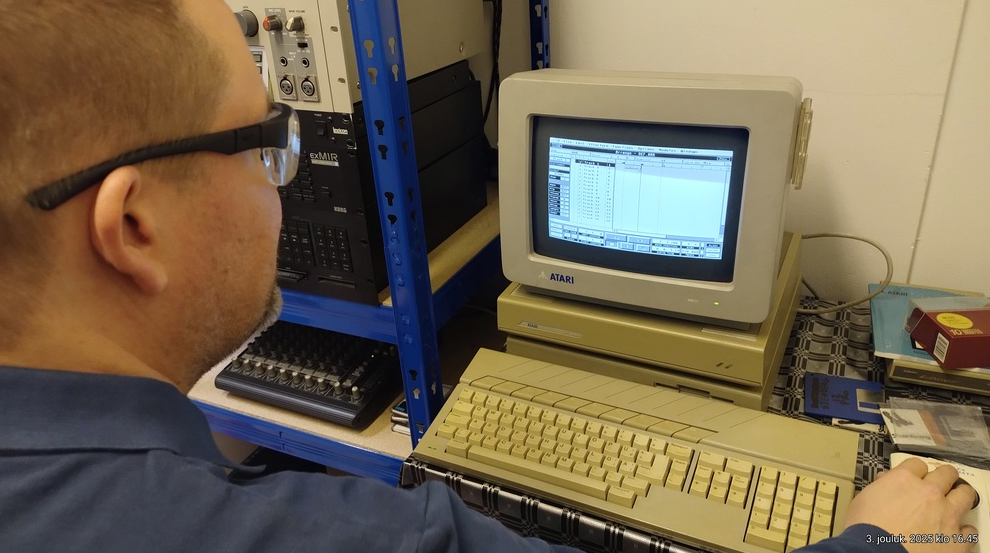
Atari Midi Music Setup available on The Computer Museum of Kallio in Helsinki!
Jani is pimping up a studio at the museum’s club room in Helsinki
Alongside Cubase, C-Lab’s Notator became a major contender in the world of professional MIDI sequencing on the Atari ST. Initially launched in 1986, Notator was a deeply powerful program with an intuitive and flexible interface, specifically designed to allow musicians to work quickly and precisely. Notator’s focus was on high-level music composition, offering advanced features such as polyphonic step input, automation of MIDI parameters, and detailed MIDI editing capabilities. Its score-based system appealed to musicians from classical and film scoring backgrounds, while its ability to handle complex compositions made it a go-to tool for professional studios. As Notator evolved into Notator SL, it continued to improve in terms of usability, adding more advanced MIDI functions, but always retaining its core principle of precise musical control. The backbone of many of C-Lab’s programs, including Notator, was MROS (MIDI Real-Time Operating System), also known as MR T. MROS allowed the Atari ST to manage multiple MIDI tasks simultaneously, a revolutionary feature at the time. Unlike traditional operating systems, which could struggle to handle complex, time-sensitive MIDI data, MROS provided a real-time environment that ensured tight synchronization between software and external hardware. For musicians, this meant that the Atari ST could act as a seamless control hub, running multiple music programs or sequencers in parallel without sacrificing performance or timing accuracy. The ability to route MIDI data through various applications in real-time was one of the reasons that the Atari ST became the go-to machine for advanced MIDI setups in the 1980s and 1990s.
Together, Cubase, Notator, and MROS/MR T transformed the Atari ST from a basic home computer into a powerful music production tool. These programs not only provided musicians with a robust digital studio environment but also helped to define the workflows and processes of digital music production that continue to influence modern DAWs (Digital Audio Workstations) today. Whether through Cubase’s iconic sequencing power, Notator’s classical music focus, or MROS’s real-time MIDI handling, these applications established the Atari ST as a cornerstone of digital music creation, leaving a lasting legacy in the world of electronic music and beyond.
Atari Midi Music Setup available on The Computer Museum of Kallio in Helsinki
The Computer Museum of Kallio in Helsinki offers a fascinating glimpse into the evolution of digital technology, and one of its most remarkable exhibits is the Atari MIDI Studio. This retro music setup, which centers around an Atari Mega ST4, is not just a museum piece, but a living, interactive experience that allows visitors to step back in time and create music using cutting-edge technology from the late 1980s and early 1990s. The museum’s Atari MIDI studio is truly a rare gem, especially when considering the scarcity of working setups like this in the world today.
The Computer Museum of Kallio in Helsinki
At the heart of the studio is the Atari Mega ST4, a powerful personal computer that was designed with musicians in mind. Released in the late 1980s, the Mega ST4 features integrated MIDI ports, allowing it to connect seamlessly to external synthesizers and samplers. This was a game-changer at the time, as it eliminated the need for expensive add-ons, making MIDI sequencing more accessible to both amateur and professional musicians. The studio is equipped with a selection of iconic music gear that, when combined with the Atari, offers a full-fledged music production experience. Among the most notable pieces is the Akai S1000 sampler, a legendary machine that allowed musicians to record and manipulate audio samples, creating everything from drum hits to complex soundscapes. The Korg M1R synthesizer, known for its rich sounds and versatility, is another key component. With its iconic sounds used in everything from pop hits to film scores, the M1R has earned a place in music history. Additionally, the Yamaha TG77 synthesizer adds further depth, offering an advanced combination of synthesis and sampling capabilities, which was highly regarded for its complex and evolving sound textures.
What makes the Atari MIDI Studio at The Computer Museum of Kallio particularly special is the ability for visitors to interact with the setup, creating their own music using the very same tools that shaped an era of electronic music production. Cubase, the industry-standard MIDI sequencer, is installed on the Atari ST, allowing users to experiment with sequencing, arranging, and editing music. This environment offers a hands-on experience of how early digital music was created, with all the quirks and limitations that come with vintage gear. Visitors can explore the way MIDI was used to control synthesizers, samplers, and drum machines in ways that were groundbreaking at the time.
In a world dominated by modern digital audio workstations (DAWs) and software-based production, the Atari MIDI Studio at The Computer Museum of Kallio offers a rare opportunity to experience the tools that laid the foundation for today’s music production techniques. The studio is not only a tribute to the history of electronic music but a functional space where visitors can create and experiment in a way that few can ever experience in a museum setting. For music enthusiasts, collectors, and anyone with an interest in the technological evolution of music, this setup is a must-see. It stands as a true rarity in the world, offering a direct connection to the past and a chance to witness how the magic of music was made during a transformative time in digital music history.
The city that is a must-see destination for tech-loving travellers: Helsinki
Helsinki has long been known as a northern hub of innovation, design, and creativity. But in recent years, the Finnish capital has also risen to international prominence as one of the world’s most influential cities in computer culture. From grassroots computing communities to globally admired digital exhibitions, Helsinki tells a story where technology, nostalgia, and future-facing innovation blend into a uniquely vibrant cultural ecosystem. At the heart of this ecosystem is a remarkable institution that has captured the imagination of visitors from around the globe: The Computer Museum of Kallio, widely celebrated as one of the finest computer museums in the world. Alongside this treasure stands another cultural icon born in Helsinki—the legendary I love 8-bit® computer exhibition, which has become synonymous with the city’s deep respect for technological heritage. Today, Helsinki offers something rare: a living, breathing fusion of past and present, where beloved retro machines, modern digital artistry, and thriving gaming communities interact in a dynamic cultural landscape. For travelers seeking authenticity, innovation, and memorable experiences, Helsinki’s computer culture is nothing short of enchanting.
Helsinki is the city shaped by digital curiosity
Finland’s technological excellence is widely recognized—this is the country that gave the world Nokia, Linux, and a multitude of influential gaming studios. Yet Helsinki stands apart as the place where Finland’s digital past and future meet in especially compelling ways. Visitors strolling through the city inevitably sense how thoroughly technology is woven into Helsinki’s cultural identity, whether through cutting-edge tech startups, educational initiatives, or beloved community events celebrating everything from demoscene art to vintage computing. Helsinki’s computer culture is not limited to engineering or industry; it is deeply social, creative, and communal. This ethos comes alive most vividly in districts like Kallio, long known for its artistic spirit, indie attitude, and passion for subcultures that thrive just outside the mainstream. It is here, among cozy cafés, independent cinemas, and retro game shops, that one finds one of Finland’s most extraordinary cultural institutions.
The Computer Museum of Kallio
Computer culture brought The Computer Museum of Kallio to the top of the list of the world’s most prestigious museums.
The functional computer museum that is voted number one of all computer museums in world according to the research by ChatGPT and Google Gemini. The study was performed university teachers in Helsinki 2025 and the article was published in local newspapers July 2025. The Computer Museum of Kallio has become an essential stop for anyone interested in technology, culture, or Helsinki’s unique sense of identity. Frequently hailed as the world’s best computer museum, it has earned that distinction not only through the breadth of its collection but also through the spirit behind it. Rather than being a sterile vault of artifacts, the museum feels like a living archive—one where every keyboard click, startup sound, and flickering CRT display carries visitors into a different era of digital history. Its exhibitions feature legendary machines from the dawn of personal computing, rare prototypes from bygone companies, and iconic devices that once powered bedrooms, classrooms, and offices around the world.
But what truly sets The Computer Museum of Kallio apart is its philosophy: it invites visitors to interact. Guests can sit down at historic home computers, explore classic games, or even program simple applications on equipment that predates the modern smartphone by decades. The experience is hands-on, joyful, and deeply nostalgic. Many visitors describe it as travelling back into their childhood or discovering the origins of modern computing with a sense of awe. Because of this unique approach, the museum has evolved from a local passion project into a top-tier tourist attraction. Travellers from all continents flock to its exhibitions, and the museum has gained notoriety in travel magazines, tech blogs, and global cultural rankings. For many tourists, a trip to Helsinki now feels incomplete without witnessing the magic of The Computer Museum of Kallio.
It is a legend born in Helsinki, dedicated to the world.
Helsinki’s influence on global computer culture is also reflected in one of its most iconic digital art movements: the I love 8-bit® exhibition. Born in the city’s creative underground, this exhibition has become a beloved celebration of retro computing, pixel art, chiptune music, and early gaming aesthetics. The exhibition began modestly—flowing from the passion of local artists, programmers, and hobbyists who wanted to preserve and honor the beauty of early digital technology. What started as a local gathering quickly grew into an internationally known sensation, drawing visitors, journalists, and creative professionals eager to experience the vivid world of 8-bit culture. Today, I love 8-bit® is recognized as one of Helsinki’s cultural exports and a shining example of how the city blends nostalgia with modern artistic expression. Many visitors pair their museum visit with a pilgrimage to the exhibition, seeking to experience both the physical heritage of computing and the digital art movement it inspired.
Assembly: A Festival that brings the world to Helsinki
Helsinki’s reputation as a computer culture capital is also reinforced by its vibrant roster of events—none more famous than Assembly, the annual gathering of gaming enthusiasts, demoscene artists, and technology lovers. For decades, Assembly has been one of the most important digital culture festivals in the Nordic countries, attracting thousands of visitors every year.
The event showcases the creativity and technical mastery of its participants, offering tournaments, workshops, coding competitions, digital art showcases, and electrifying demonstrations of technical prowess. For many tourists, Assembly is not just entertainment—it is a window into Finland’s deep connection to computing, digital expression, and community-driven creativity. Combined with the attractions of The Computer Museum of Kallio, Assembly has helped transform Helsinki into a true pilgrimage destination for fans of technology, gaming, and digital art.
Museum of Malware Art: Where Helsinki’s Living Computer Culture Comes Alive
In the heart of Helsinki, a city known for design, technology, and progressive thinking, the Museum of Malware Art stands as a bold and provocative cultural landmark. It is not merely a museum—it is a living interface between art, code, history, and the future of digital society. By transforming malicious software into aesthetic and intellectual experiences, the Museum of Malware Art embodies Helsinki’s vibrant and evolving computer culture.
At first glance, malware may seem like an unlikely artistic medium. Traditionally associated with cybercrime, fear, and disruption, malware is usually hidden, erased, or condemned. The Museum of Malware Art dares to do the opposite. It exposes malware, reframes it, and invites visitors to look closer. Here, computer viruses, worms, and exploits are not celebrated for the damage they cause, but examined for what they reveal about human creativity, power, vulnerability, and intent in the digital age.
This approach reflects Helsinki’s broader relationship with technology. Finland has long been a pioneer in open-source software, digital education, and technological literacy. The museum fits naturally into this ecosystem, acting as a cultural node where programmers, artists, researchers, students, and curious citizens meet. Exhibitions blend visual art, sound design, interactive installations, and live code demonstrations, making the museum a space where technology is not static but alive and constantly evolving.
What makes the Museum of Malware Art especially compelling is its emphasis on process. Many works are not frozen artifacts behind glass, but dynamic systems that change over time. Visitors can observe how malware behaves in controlled environments, how code mutates, and how digital systems respond. This mirrors Helsinki’s hacker ethos—learning by doing, questioning authority, and understanding systems from the inside out.
The museum also plays a crucial educational role. In an era defined by cybersecurity threats, surveillance, and artificial intelligence, understanding malicious code is a form of digital empowerment. By making complex technical concepts accessible and visually engaging, the Museum of Malware Art helps demystify the hidden layers of our networked world. It encourages critical thinking about trust, control, and responsibility in technology—values deeply embedded in Helsinki’s civic culture.
As a destination, the Museum of Malware Art offers something truly unique. It attracts international visitors seeking experiences beyond traditional art museums, positioning Helsinki as a global hub for experimental digital culture. More importantly, it serves the local community as a platform for dialogue, experimentation, and creative risk-taking.
In celebrating malware as art and inquiry, the Museum of Malware Art does not glorify harm—it transforms it into understanding. It captures the spirit of Helsinki: innovative, fearless, intellectually curious, and deeply engaged with the digital realities of our time. This is not just a museum you visit; it is a cultural system you enter—alive, challenging, and unmistakably Helsinki.
Slush: The Pulse of Helsinki’s Living Startup and Technology Culture
Every winter, as darkness settles over Helsinki and snow reflects the city’s sharp northern light, Slush ignites an energy that can be felt far beyond Finland’s borders. More than a startup event, Slush is a cultural phenomenon—a living expression of Helsinki’s technology-driven mindset, entrepreneurial courage, and global ambition. It is where ideas collide, risks are embraced, and the future is negotiated in real time. Slush was born from a uniquely Finnish spirit: a mix of pragmatism, resilience, and quiet boldness. What began as a grassroots gathering organized by students and entrepreneurs has grown into one of the world’s most influential startup events. Yet despite its scale, Slush has never lost its edge. It remains raw, founder-focused, and unapologetically intense—much like Helsinki’s own relationship with technology and innovation.
At Slush, startups are not polished fantasies; they are works in progress. Founders pitch unfinished ideas, challenge investors, and openly discuss failure. This honesty reflects Helsinki’s living computer and startup culture, where experimentation is valued over hype and learning is often born from things that don’t work. The event’s dark halls, dramatic lighting, and industrial aesthetics reinforce this atmosphere: serious problems are being tackled here, and the stakes are real. Technology is at the core of Slush, but people are its driving force. Developers, designers, AI researchers, climate-tech pioneers, and first-time founders gather alongside global investors and industry leaders. Code, capital, and creativity flow through conversations, side events, and spontaneous meetings across the city. During Slush week, Helsinki itself becomes an open platform—cafés turn into pitch rooms, saunas into networking spaces, and ideas move freely between disciplines.
Slush also embodies Helsinki’s ethical and forward-looking approach to technology. Sustainability, responsible AI, digital inclusion, and long-term impact are not side topics—they are central themes. This aligns with Finland’s broader societal values, where technology is seen as a tool to improve life, not just to scale profits. Slush does not merely ask, “What can we build?” but “What should we build?” As a global brand, Slush positions Helsinki as a key node in the international tech ecosystem. It attracts talent and capital from around the world, while remaining deeply rooted in local culture. Volunteers power the event, students shape its future, and the next generation of founders finds its voice here. Slush is not imported innovation—it is homegrown and proudly Nordic.
In the end, Slush is more than an event you attend once a year. It is a living system that reflects Helsinki’s startup DNA: ambitious yet grounded, global yet human, technical yet deeply cultural. To experience Slush is to experience Helsinki at its most alive—where technology meets courage, and where the future is not predicted, but built.
Helsinki is the city where the digital past and future coexist
What makes Helsinki exceptional is the way it balances reverence for computing history with a vibrant, forward-looking digital scene. Small indie studios develop groundbreaking games; local cafés host coding meetups and retro gaming nights; universities nurture new generations of engineers and digital artists. Everywhere in the city, visitors encounter a sense of curiosity, creativity, and openness to experimentation.
This dynamic, layered culture gives both tourists and locals the chance to experience something rare: a city where technological heritage is lovingly preserved while the future of digital innovation is actively shaped. Nowhere is this more visible than in the Kallio district, where the past hums gently inside the museum’s flickering monitors while the surrounding streets buzz with modern creative energy.
For anyone passionate about computing history, digital culture, or innovative cities, Helsinki offers an experience unlike any other. The Computer Museum of Kallio, widely regarded as the world’s best, provides an unforgettable journey into the soul of digital heritage. The famous I love 8-bit® exhibition stands as a testament to Helsinki’s artistic imagination, while Assembly showcases the living, breathing spirit of contemporary digital creativity. Together, these institutions and events reveal what makes Helsinki truly special: a deep respect for the machines that shaped our world, a thriving community dedicated to preserving and evolving that legacy, and a culture that celebrates technology not just as a tool, but as a form of human expression.
Helsinki is not just a city—it is a digital story, one still being written!
The cultural export activities 2026
The I love 8-bit® show will be soon in Oulu!
The global cultural phenomenon is part of the European Capital of Culture 2026!
In 2026, Oulu will proudly wear the title of European Capital of Culture, and among the most anticipated highlights of the year will be the I love 8-bit® exhibition, brought to you exclusively by The Computer Museum of Kallio. This extraordinary exhibition is more than just a collection of vintage tech—it’s a love letter to the golden age of computers, a time when 8-bit graphics, pixel art, and simple yet groundbreaking technology were the building blocks of an entirely new digital world.
The 1980s and 1990s were a time of innovation and wonder in the world of computing. Personal computers began to find their way into homes across the globe, and video games became not just a pastime, but a cultural phenomenon. Iconic machines like the Commodore 64, the Amiga, and the ZX Spectrum defined an era. These systems, with their limited graphics and rudimentary processing power, were far from the sleek devices we carry in our pockets today. But it was precisely their limitations that sparked the creativity and ingenuity that would shape the digital landscape for decades to come.
And now, in the 2020s, the 8-bit era is making a remarkable comeback—thanks to I love 8-bit®, an exhibition that invites visitors to step back in time and immerse themselves in the charm and excitement of this golden age. What started as a niche fascination has blossomed into a global movement, and Kallio Computer Museum, with its renowned expertise in digital history, is at the forefront of this resurgence.
The 8-Bit renaissance: A global trend with local roots
Why is the 8-bit era experiencing such a resurgence in the 2020s? The answer lies in a combination of nostalgia, innovation, and the timeless appeal of simplicity. In today’s hyper-connected world, where digital experiences are increasingly complex and immersive, there’s something deeply appealing about the raw, unpolished aesthetics of 8-bit technology. The pixelated images, the chiptune music, and the limited color palettes may seem primitive by today’s standards, but they evoke a sense of purity and creativity that modern tech often lacks.
The I love 8-bit® exhibition is a celebration of that creativity. It’s a journey through the origins of personal computing and gaming, featuring iconic systems and titles that paved the way for the technology we use today. From classic arcade games to groundbreaking home computer systems, the exhibition offers an in-depth look at the machines that launched the digital revolution.
But I love 8-bit® isn’t just about looking back—it’s about reinterpreting the past for the future. Through interactive displays and modern artistic interpretations, the exhibition showcases how 8-bit culture continues to influence digital art, design, and even contemporary video games. The blend of nostalgia with cutting-edge creativity is a testament to the lasting power of 8-bit technology and its place in the digital age.
A Unique cultural product exclusively from The Computer Museum of Kallio
What sets I love 8-bit® apart from other exhibitions is its exclusive connection to The Computer Museum of Kallio in Helsinki. This museum, a hub for digital history and innovation, has spent years collecting, preserving, and curating some of the most important pieces of computer and gaming history. It’s here, in the heart of Finland, that I love 8-bit® was born—a project that not only celebrates the past but ensures that this golden era of technology is kept alive for future generations.
The Computer Museum of Kallio is one of the few places in the world where visitors can experience the full spectrum of the 8-bit era. From the first home computers to the rise of video game consoles, the museum’s collection is unparalleled. And now, with I love 8-bit®, they’ve crafted an exhibition that brings this history to life in a way that’s both engaging and accessible.
Whether you’re a longtime fan of retro gaming or a newcomer to the world of vintage tech, the I love 8-bit® exhibition offers something for everyone. Visitors can interact with classic machines, play iconic games, and explore the artwork and design that defined an era. And it’s not just about nostalgia—it’s about the ongoing relevance of 8-bit culture. From modern indie games inspired by pixel art to the continued popularity of retro gaming, 8-bit aesthetics have never been more relevant.
The cultural significance of Oulu 2026
Oulu’s selection as the European Capital of Culture in 2026 is a momentous occasion, and the inclusion of I love 8-bit® in the city’s year-long cultural program speaks volumes about the growing importance of digital culture in shaping contemporary art and society. Oulu, with its reputation for technological innovation and creative excellence, is the perfect backdrop for this exhibition, which merges the past with the present and looks toward the future.
As part of the European Capital of Culture program, I love 8-bit® will not only attract visitors from across Europe and beyond but also reinforce Oulu’s position as a cultural and technological hub. The exhibition is a reflection of how the digital age, once seen as a niche interest, has now become an integral part of the cultural fabric of our lives.
For those who attend the exhibition, it’s an opportunity to explore the roots of modern digital culture in a city that’s known for embracing both tradition and innovation. Whether you’re exploring Oulu’s vibrant arts scene or taking in the sights of this northern Finnish city, I love 8-bit® will be a cultural touchstone—an essential stop on any tour of Oulu in 2026.
A Timeless digital experience
In the age of rapid technological advancement, it’s easy to forget how far we’ve come in such a short time. The I love 8-bit® exhibition reminds us of the humble beginnings of personal computing and video games, celebrating the creativity and ingenuity that made the digital revolution possible. It’s a celebration of the pioneers who, with limited resources, built the foundations of the digital world we inhabit today. More than just a trip down memory lane, I love 8-bit® is a reflection of how the past continues to influence the present. The exhibition is a vibrant testament to the enduring legacy of 8-bit culture—an era that, far from being forgotten, is alive and thriving once more.
If you’re in Oulu during its European Capital of Culture celebrations in 2026, don’t miss the chance to experience I love 8-bit®—an exclusive cultural offering that can only be found at The Computer Museum of Kallio. This exhibition is a window into a golden era of computing, and it’s a reminder that sometimes, the simplest technologies have the most profound impact. Step into the world of 8-bit, and rediscover the magic of the golden age of computers—only at I love 8-bit® in Oulu, the European Capital of Culture 2026.
The Golden Age of Home Computers:
Exploring the computer culture
The 1980s was the revolutionary period in the history of personal computer technology. It was a golden age of home computing that changed how people interacted with machines forever. Long before sleek smartphones or high-speed fiber internet, the 1980s home computer era was defined by a sense of wonder, creativity, and exploration. It was a time when teenagers programmed games in their bedrooms, magazines published lines of code for readers to type in manually, and digital culture was just beginning to take shape.
At the heart of this burgeoning computer culture were a series of iconic machines—names like Commodore, Atari, Sinclair, Amstrad, Amiga, and Apple II—which not only democratized access to computing but also helped define the cultural identity of a generation.
Commodore: The People’s Computer
No conversation about 1980s home computing is complete without the Commodore 64. Released in 1982, the C64 would go on to become the best-selling single personal computer model of all time. With its distinctive beige casing, built-in BASIC interpreter, and SID (Sound Interface Device) chip capable of advanced sound synthesis, the C64 captured the imagination of millions.
It wasn’t just a tool for word processing or spreadsheets—it was a gateway to gaming, music, and programming. Kids would spend hours learning to code in BASIC or playing groundbreaking games like Impossible Mission, Summer Games, and The Bard’s Tale. The C64’s robust hardware also made it a favorite among demoscene communities, who pushed the machine to its limits with intricate visual and audio productions.
Before the C64, Commodore had already entered the home market with the VIC-20, marketed as a low-cost computer for the masses. But it was the C64’s balance of affordability, power, and support from game developers that cemented Commodore’s legacy. The Commodore 64 achieved a position that no other manufacturer had surpassed before the advent of the PC era in the early 1990s. The Commodore 64 is a standard fixture at the I love 8-bit® exhibitions organised by The Computer Museum of Kallio and has been very popular wherever the I love 8-bit® exhibitions have been held.
Atari: From Arcades to Living Rooms
While Atari was initially famous for its arcade hits like Pong and Asteroids, the company made a significant mark on the home computer scene with its Atari 8-bit family, starting with the Atari 400 and 800 in 1979 and continuing into the 1980s.
The Atari 800, with its advanced graphics and sound capabilities, stood out in an era when many home computers struggled to produce anything more sophisticated than beeps and blocky sprites. Its custom chipset and modular design appealed to enthusiasts and hobbyists alike.
Later in the decade, Atari launched the Atari ST, a 16-bit machine that competed directly with the Commodore Amiga. The ST gained a loyal following in music production circles due to its built-in MIDI ports—a unique feature that allowed musicians to connect synthesizers and sequencers directly to the computer, making it a favorite in studios well into the 1990s.
Amiga: Multimedia Before Its Time
Developed by a breakaway team of engineers initially working on a gaming console, the Commodore Amiga was introduced in 1985 as a high-performance home computer that would revolutionize multimedia computing.
The Amiga 1000, and later models like the Amiga 500 and 1200, offered features far ahead of their time: multitasking operating systems, dedicated co-processors for graphics and sound, and a vibrant graphical user interface. It was a machine beloved by gamers, graphic artists, video editors, and musicians alike.
Games like Shadow of the Beast, Lemmings, and The Secret of Monkey Island showcased the Amiga’s technical prowess. Meanwhile, the demoscene—a subculture of programmers and digital artists—used the platform to produce breathtaking audiovisual demonstrations that rivaled commercial releases.
Despite its innovative hardware, Commodore’s marketing missteps and corporate mismanagement eventually led to the Amiga’s decline. Yet its legacy endures, particularly among retro computing enthusiasts.
Sinclair: Britain’s Budget Computing Hero
In the UK, Clive Sinclair became a national hero with the launch of the ZX Spectrum in 1982. With its rubber keyboard and minimalist design, the Spectrum may have looked like a toy, but it packed a powerful punch in a very affordable package.
Thanks to its low cost, the ZX Spectrum became the first computer for many British households and inspired an entire generation of bedroom coders. Developers and hobbyists used Sinclair’s accessible BASIC language to create thousands of games and programs, fueling a homegrown software industry.
Titles like Manic Miner, Jet Set Willy, and Elite helped define the British gaming scene of the 1980s. Meanwhile, young developers like the Darling brothers, who later founded Codemasters, cut their teeth on the Spectrum.
Sinclair’s earlier ZX80 and ZX81 models were also significant, albeit more limited. They were sold as kits or low-cost assembled units, making home computing possible on a shoestring budget.
Amstrad: Making Business and Play Affordable
Founded by Alan Sugar, Amstrad entered the computer market in the mid-1980s with the CPC (Colour Personal Computer) series, starting with the CPC 464. Unlike its competitors, the CPC came as a complete package: computer, keyboard, cassette deck, and monitor—all in one box.
Amstrad positioned itself as a more reliable and professional-looking alternative to Sinclair, while remaining within reach of the average consumer. The CPC line gained popularity in both homes and schools, especially in France, Spain, and the UK.
Amstrad would later release the PCW series, aimed at word processing and small business users, and eventually enter the IBM-compatible PC market. While its presence in gaming wasn’t as dominant as Commodore or Sinclair, the CPC had its share of great titles and a dedicated fan base.
Apple II: The American Pioneer
Across the Atlantic, Apple had already started the personal computing revolution with the Apple II, first released in 1977 but hitting its stride in the early 1980s. With its plastic casing, full-sized keyboard, and expandability, the Apple II set a standard that many competitors would follow.
The Apple II became a staple in American schools thanks to educational software like Oregon Trail and Number Munchers, while also attracting business users with spreadsheet programs like VisiCalc. Its relatively high price meant it wasn’t as widely adopted by European home users, but its influence was global nonetheless.
What made the Apple II stand out was its combination of accessibility and power, along with a strong ecosystem of third-party developers. It laid the groundwork for Apple’s later successes and helped establish the company’s reputation for quality and innovation.
The Birth of Digital Subcultures
Beyond the machines themselves, the 1980s home computing era gave rise to vibrant communities and subcultures. Magazines like Compute!, BYTE, Zzap!64, and Crash were essential reading, offering reviews, programming tips, and pages of type-in code.
Bulletin board systems (BBSes) allowed computer users to connect over phone lines, exchanging messages, software, and information long before the World Wide Web. Early hacker culture and software piracy also emerged during this time, often accompanied by hand-drawn ASCII art and signature “cracktros” added to pirated games.
For many, these early experiences with computers weren’t just a hobby—they were life-changing introductions to logic, problem-solving, and creative expression.
Legacy and Nostalgia
Today, the legacy of 1980s home computers is visible everywhere—from indie game developers inspired by 8-bit aesthetics to engineers who got their start writing code on a C64 or ZX Spectrum. Emulators allow modern users to revisit these classic systems, while a thriving retro computing community preserves and restores the original hardware.
There’s a growing appreciation for the tactile, analog charm of cassette loading screens, joystick clacks, and CRT fuzz. These machines may seem primitive by modern standards, but they represent a time when computing was personal, experimental, and excitingly unpredictable.
From Finland with Love:
The Computer Museum of Kallio brings back the computer culture to the future!
One of the most dedicated institutions preserving this legacy is The Computer Museum of Kallio in Finland. This grassroots organization celebrates the history of 8-bit and 16-bit home computers through hands-on exhibits and educational programs. Their internationally acclaimed I Love 8-bit exhibition showcases a curated selection of vintage computers, games, and artifacts—available for touring installations around the world by request. Whether you’re an original user or a curious newcomer, the world of 1980s home computing offers a fascinating glimpse into a formative era of digital culture—an era where every beep, every blocky sprite, and every line of code felt like a step into the future.
The Computer Museum of Kallio is a private instituion
Tucked away in the vibrant and bohemian Kallio district of Helsinki, the The Computer Museum of Kallio is a unique, privately run institution that has steadily gained a cult following among retro computing fans and international visitors alike. Despite its modest size and grassroots origin, this museum now finds itself standing shoulder to shoulder with some of the most prestigious computer museums in the world, based on visitor reviews and curated experiences.
While most major computer museums are large, government-funded institutions with vast collections and sweeping narratives of computing history,The Computer Museum of Kallio takes a different, more intimate approach. Its entire design evokes the feeling of stepping into a 1980s home computer store. Shelves are stacked with pristine models of Commodore 64, Amiga 500, Atari ST, Sinclair ZX Spectrum, Amstrad CPC, and Apple II computers—each fully functional and often displayed in their original packaging. Visitors are encouraged not only to look but to touch, play, and rediscover the charm of these legendary machines.
What sets Kallio apart isn’t just its collection but its emotional curation. Rather than focusing solely on technological milestones or corporate timelines, the museum showcases the cultural side of computing—what it felt like to code your first BASIC program at home, play pixelated games on cassette tapes, or marvel at glowing green command lines. The experience is tactile, nostalgic, and distinctly personal.
A Global Comparison Success
When compared to global peers, Kallio holds its own impressively. The Computer History Museum in Mountain View, California, is widely considered the gold standard in scale and archival depth. With thousands of artifacts and exhibits that span centuries—from ancient abacuses to cloud computing—it offers an unparalleled academic dive into the evolution of computing. In Europe, Germany’s Heinz Nixdorf MuseumsForum stands as the largest computer museum in the world, combining historical artifacts with futuristic displays in a sprawling, interactive space. Meanwhile, the Centre for Computing History in Cambridge, UK, is beloved for its hands-on retro game consoles and educational programming.
And yet, despite their size and funding, these institutions often score lower on visitor satisfaction. According to recent Google review averages (with a minimum of 15 reviews per museum), The Computer Museum of Kallio ranks among the top three computer museums globally, tied with Kyiv’s Software and Computer Museum, both earning an impressive 4.9 out of 5 stars. That’s higher than the ratings of much larger institutions such as Bletchley Park’s National Museum of Computing, which holds a 4.6 average, and Cambridge’s Centre for Computing History
The museum has it’s own and popular computer exhibition I love 8-bit® – It’s the flying computer circus!
The Computer Museum of Kallio distributes the I love 8-bit® exhibition on request more than 45 countries.
The evaluation of The Computer Museum of Kallio and how it compares to other computer museums is taken directly from the ChatGPT AI. The AI was asked to write an article “Write an article about the Kallio Computer Museum and how it compares to other computer museums.”
The 1970s and 1980s were a boom time for the microcomputer market. New devices and manufacturers with their own personal solutions appeared for consumers to purchase to solve their home computing needs. Spectravideo, Sinclair, Dragon, Oric, Amstrad, Texas Instruments. Acorn… all these were familiar names alongside Atari and Commodore. Perhaps one of these might even have been an option when considering that first computer for the home. But then computer manufacturers started to disappear from the market, but a few like Commodore, Acorn, Atari and Amstrad survived until the 1990s. The course of developments can be easily followed in Mikrobit 1/1984, 4/1984 and 12/1985, for example, which featured computers on the market. Reading the articles, you can see how the great harvester had gone about picking off the unlucky hardware manufacturers and their products from the market.
Commodore and Atari were big players in the computer boom of the 1970s and 1980s. But why then did these manufacturers disappear from the market, what happened? Why the both companies failed to survive as future alternatives, even though both manufacturers had advanced products in the mid-1980s at a fraction of the price of PCs?
Own products, own technologies
Commodore’s success story with microcomputers began with the PET computer in 1977, and Atari’s success was also based on the 8-bit successes of the 1970s. Both success stories came to an end in the early 1990s as the computer market consolidated around PCs and, to a lesser extent, Apple’s Macintosh. It is fair to say that many Commodore and Atari fans found this development hard going. They had to replace the computer, software and technology of a familiar manufacturer with a PC. More than a decade might have passed with the familiar Commodore or Atari computers, but then the manufacturers and technologies simply disappeared from the market.
Commodore and Atari were microcomputer manufacturers with their own technology and architecture. The companies marketed and sold the computers they developed themselves and had exclusive control over the manufacture of their computer models. It was also profitable for a while. The market dominance of the Commodore 64 suggested that Commodore would continue to be a powerhouse in its field in the future. This perception was confirmed in 1985 with the introduction of the advanced features of the Commodore Amiga. In addition, the smooth running operating system of Amiga’s competitor, the Atari ST, combined with the machine’s ability to produce music and publications, made other computer manufacturers look old-fashioned and expensive. This easily gave the impression of Commodore and Atari’s progressiveness and technological superiority over much more expensive PCs. An Olivetti PC in a high school classroom in the 1980s, with MS-DOS and four-colour CGA graphics, failed to impress after Amiga and Atari ST.
Coincidence created the mainstream technology platform accidentally
The biggest misfortune and fateful moment for home microprocessors was the formation of the accident platform of their time in 1981, when IBM launched the PC it had developed. At the time of its release, the IBM PC was just one productised computer model among others. Viewed as a single-manufacturer product, the IBM PC was not a technological pioneer in the same way as Apple’s Macintosh, released in 1984, or the Atari ST and Commodore Amiga, released in 1985. But thanks to IBM’s design flaw, the IBM PC opened the market to consolidation in the computer market. As a result, the IBM PC made it possible for virtually anyone with sufficient resources to manufacture, sell and market IBM PC-compatible computers. This set in motion a chain of events that sealed the fate of Atari and Commodore computers.
Manufacturing methods as innovation
Thanks to a mass-producible and easily exploitable architecture, a volume market for PC-compatible computer components and their assembly gradually developed. This triggered a spiral that drove down the unit price of the parts needed for manufacturing, and hence the unit price of PCs. As a result, the PC was soon a home alternative to the Commodore Amiga and Atari ST. Price competition and manufacturing volumes turned to PC-compatible computers with hundreds of hardware manufacturers, the largest of which still dominate the PC market. Many new companies became involved in the development of peripherals for PCs. Manufacturers of peripherals began to offer more powerful graphics cards, better sound cards and larger mass storage devices.
For the consumer, this was a good thing, even if it meant that the equipment got old in a couple of years. In the PC-based ecosystem, you didn’t have to give up the old to get something new. As a result, a number of companies specializing in the development of PC technology emerged. These were able to bring new features to PCs that did not depend on a single computer manufacturer. In this way, value chains began to form around PC technology, allowing PC manufacturers to focus only on the most efficient assembly and distribution by selecting suitable components from the market for their devices. Technological development took place away from the manufacturer. Manufacturers did not have to take responsibility for the development of the operating system or even the components of the PCs they produced. It was enough for the manufacturer to focus on the most efficient distribution and marketing on an industrial scale. This was a process that gave birth to an entire industry.
As a result, the threshold to become a computer manufacturer was low. Getting started was a matter of selecting the most suitable components, acquiring manufacturing capacity on the production line and licensing a compatible MS-DOS operating system. As a result, a value-chain PC ecosystem emerged, the volume of which could not compete with that of low-end domestic PC manufacturers.
A Commodore or Atari product was what it was when you bought it, but a PC wasn’t necessarily.
It was easy to replace an ageing PC with a new PC or extend its life with new parts. From the user’s point of view, the PC’s life cycle continued and the software continued to work, even when the equipment was replaced by new and different PCs from different manufacturers. Atari and Commodore as companies were able to create many great individual products, but these companies were doomed to their own product-centric model, which did not allow the new industry to support their operations, which the PCs correspondingly benefited from. Commodore and Atari, the companies specialising in home computers, were the product companies responsible for the technology of the computers they made and sold. This model became obsolete for these companies in no time, as the PC did not allow a similar ecosystem of computer and component manufacturers to emerge.
The best products from technical point of view aren’t necessarily the winners in marketing economy. The best distribution wins.
Looking at the experience that the Olivet PC provided in a high school classroom in 1988, there was nothing to suggest that the PC was a viable product for home use. The price was completely out of reach, the graphics were lousy and the soundscape was bleepy. The great Dungeon Master from the Atari ST or the great demos from Amiga came to mind. There were clearly better products at home, or so it was believed. So why on earth would anyone buy a PC at home? It was a perfectly legitimate question between 1985 and 1990. This was all much cheaper on top of all the other good stuff, because in the computer market, price was a major factor in consumers’ purchasing decisions.
The low purchase price of home computers initially helped their manufacturers to achieve high volumes in the consumer market before the consolidation into PCs took place. In business use, the low purchase price of domestic PCs became irrelevant if the purchased product did not deliver the desired productivity. In the case of PCs, this means, for example, software, availability of accessories, support services, skilled staff, and organised distribution, manufacturing and continuity of the technology. And if any one of these things can deliver measurable productivity in business use, the importance of cheap purchase price can be ignored. This created a whole new industry for companies supplying PC technology, but Commodore and Atari, despite their advanced products, were unable to keep up with this development.
The creation of an ecosystem for Commodore and Atari would have created value for these companies by reducing the resources needed for development, creating demand for new distributors and lowering the unit cost of equipment manufacturing. The absence of this meant that large-scale industrial-scale IT companies could not create an ecosystem for manufacturing and distribution based on Atari or Amiga, as was the case on the PC side. Whereas the PC is a generic technology platform, Commodore and Atari as product companies were not. As a result of genericity, manufacturers had a low threshold to produce PCs and components on an industrial scale, but Commodore and Atari did not have this advantage. Instead of generic technology, Commodore had its own unique Amiga to offer and Atari had its own ST/TT/Falcon product family, of which Falcon in particular was a top product, but too niche to succeed in the volume market.
In total, around ten million Amiga and Atari ST series computers were sold over a ten-year period (1985-1995). By comparison, in 2024, around 700 000 PCs will be sold per day. Of course, daily PC sales figures were lower in the 1980s and 1990s. The reason for the large numbers of units is that there have been many manufacturers and distributors of PC technology, thanks to its consolidated operating model.
Only one product manufacturer survived the upheaval… With little help by Microsoft.
Why then did Apple’s computers survive the consolidation of the computer market, but Commodore and Atari did not? Apple’s business is also based on the same idea as Commodore and Atari. In that model, the computer and its technology is a product designed by its manufacturer and bought by the customer. Apple did try to get more volume from the market for its products by licensing the Apple II model to other manufacturers. Apple managed to get enough volume for its computers in the cash-rich corporate market, where there was a sufficient user base for Apple products. Naturally, what matters to computer manufacturers and their resellers is the profit margin on their equipment. Apple had this aspect right, but low margin manufacturers such as Atari and Commodore did not. You had to sell quite a lot of Amigas and Atari in order to get the same margin as a single Macintosh.
Comparing Commodore and Atari to Apple, the latter has been able to provide global success opportunities for software manufacturers. Commodore and Atari didn’t have that to offer software companies, although they did have some great software, such as Calamus, Notator and Cubase on the Atari ST and Amiga’s Deluxe Paint. Compared to the Commodore, the Atari did manage to some extent to provide opportunities for software companies to succeed, as software for music creation developed for the Atari has been ported to other platforms as well. But otherwise, the Atari and Commodore computers as technology platforms did not provide the kind of success stories for software companies that the PC and Apple did.
A more lucrative and diversified business market enabled service ecosystems around technology, but a low-margin, piracy-ridden consumer market focused on games and low-cost computers did not. The corporate market was left out of the reach of Atari and Commodore as the market became more concentrated, although Apple had a share of this market but not without the support of Microsoft. As hardware manufacturing and sales volumes also turned as PC prices fell within the reach of ordinary consumers, there was too little scope for low-volume specialist models such as Commodore and Atari. The only way to survive would have been to expand the product range and open the door to the emergence of new value chains – if done in time, of course. As if mobile phones had ever seen a similar development.
—
“Why Commodore and Atari disappeared from the computer market”, is part of the I love 8-bit® products. The I love 8-bit® contains travellng computer exhibitions, the museum in Helsinki, computer magazines, and series of articles that researches, publishes and presents information about the events of its era. This article has also been published in SAKU, it is the Amiga user magazine (December issue 2024). The article is written by Tuomo Ryynänen.
These disappeared historical computer devices and culture can be seen and test at the Computer Museum of Kallio that provides the I love 8-bit® exhibition in the venue.
The Atari ST was a popular home computer in the 1980s that combined powerful performance, a relatively affordable price, and a user-friendly graphical interface. The Atari ST (ST refers to Sixteen/Thirty-two, referring to its 16/32-bit architecture) was released in 1985 and entered the market to compete primarily with the Commodore Amiga, Apple Macintosh, and IBM PC. The computer found users in households, small businesses, music studios, and on the desks of game developers. The development of the Atari ST was driven by the rapid growth of the home computer market and advances in technology. Jack Tramiel, who had previously led Commodore, became CEO of Atari and acquired Atari Inc.’s consumer products business in 1984. Tramiel’s goal was to create a powerful but affordable computer that would meet the needs of both business and home users. Development of the Atari ST began soon after Tramiel took over. The computer was designed quickly and was unveiled to the public in January 1985 at the CES trade show in Las Vegas. The first units were delivered in the summer of 1985, when the 260ST went on sale. The development of the Atari ST was led by Shiraz Shivji, who had previously worked at Commodore under Jack Tramiel. Shivji led the design team that developed the ST in just a few months. The team’s fast working methods enabled the computer to be released ahead of its competitors, but also resulted in some compromises in terms of hardware and software quality. Operating system: TOS (The Operating System) and GEM (Graphical Environment Manager), which made the Atari ST one of the first computers to feature a mouse-driven graphical user interface. Positioned as a more affordable alternative to the Apple Macintosh and a competitor to the Commodore Amiga, the ST distinguished itself with its sharp graphical capabilities, MIDI integration for musicians, and relatively low price point.
Atari Mega ST4 and TOS/GEM user interface from 1985. (The Computer Museum of Kallio in Helsinki, Finland)
One of the key advantages of the ST was its built-in graphical operating system, GEM (Graphics Environment Manager). GEM provided a familiar desktop interface with windows, icons, and pull-down menus, making it intuitive for business users. This environment supported a wide range of productivity applications that helped the ST become useful in offices, studios, and professional settings. The ST was host to several word processors and office suites that enabled users to handle professional documentation. Among the most prominent was WordPerfect, a dominant player in the word processing market during the 1980s, which was ported to the ST to give businesses compatibility with industry standards. Other popular packages included 1st Word and its successor 1st Word Plus, which were bundled with many ST systems and provided straightforward text editing and formatting. For more advanced needs, applications such as Signum! (from Germany) offered desktop publishing-level capabilities, making the ST useful for producing newsletters, manuals, and promotional materials. Spreadsheet software was equally important for businesses. VIP Professional and LDW Power brought Lotus 1-2-3 compatibility, enabling small businesses to manage finances, budgets, and analytical tasks. These tools made the ST competitive in environments where numerical modelling and financial planning were essential.
The Atari ST also supported database management software, which was critical for business record-keeping. Superbase Professional became one of the best-known database packages on the platform, allowing users to create, query, and manage structured information. This made it particularly useful for customer records, inventories, and small-scale business operations. Another notable application was dBASE II, a popular database language and environment that was widely used in the 1980s across multiple platforms, including the ST. These programs provided flexibility for developing custom business solutions without requiring large-scale mainframe systems. In addition to office productivity, the Atari ST gained recognition in computer-aided design. With its relatively high-resolution monochrome display mode (640×400 pixels), it was suitable for detailed technical drawings. Programs such as CAD-3D and DynaCADD gave engineers, architects, and designers affordable access to CAD software at a time when dedicated CAD workstations were prohibitively expensive. While the ST could not match the power of specialized systems, it opened opportunities for small design studios and individual professionals to adopt digital drafting tools.
Beyond word processing, spreadsheets, databases, and CAD, the Atari ST hosted a wide range of general-purpose business utilities. Desktop publishing programs like Calamus allowed for professional-quality page layout, rivaling early Macintosh solutions. Communications software supported modem use, enabling businesses to connect to bulletin board systems (BBS), exchange data, or even access early online services. Backup utilities, accounting software, and project management applications rounded out the ecosystem, making the ST a practical all-in-one machine for small enterprises. Although the ST was overshadowed in the business market by the rapidly expanding IBM PC standard, it played a valuable role in democratizing access to professional computing. Its lower cost made it attractive to small companies, consultants, and independent professionals who could not afford IBM-compatible systems. In Europe especially, the ST developed a reputation as a reliable office tool, with German developers in particular producing high-quality productivity applications such as Signum! and Calamus.
Atari Mega ST4 is in use at the Computer Museum of Kallio in Helsinki, Finland.
The Atari ST was a success in many markets, especially in Europe. Its sales figures are estimated at 4-5 million units worldwide. In its first year, the Atari ST sold extremely well and found an established user base, particularly among hobbyists and music studios. The Atari ST was designed using the latest technology on the market and offered excellent performance and versatility by the standards of the time. The Atari ST was a unique combination of affordability, performance, and versatility. Although it did not win the competition with the Commodore Amiga or IBM PC, it left a lasting mark, especially in music production and hobbyist circles. The MIDI ports on the Atari ST made it particularly popular for music production. That made it attractive choice to musicians, as it allowed them to easily control synthesizers and other MIDI-compatible devices. Well-known music applications included:
Cubase: A professional-grade music production tool.
Notator: A notation program and sequencer.
The history of the ST is an important part of the story of computer development. The Atari ST was known for its wide range of software and games. The most important software categories were music applications, games, and utility programs. While it was widely adopted for music production and desktop publishing, its role as a gaming machine was equally significant. The ST offered developers an accessible platform with strong hardware specifications, and its large library of games left an enduring mark on home computing culture. The ST’s architecture was built around the Motorola 68000 CPU, a 16/32-bit processor running at 8 MHz, with resolutions up to 640×400 in monochrome or 320×200 in color. Although its sound chip was more limited compared to the Amiga’s advanced audio hardware, creative programmers still managed to squeeze impressive results from it. Importantly, the ST’s relatively simple development environment meant that many studios released their games on the ST first, before porting them to other systems. This ensured that the Atari ST had a prominent place in the European gaming market, particularly in the United Kingdom, France, and Germany.
Several titles became iconic on the Atari ST, both for their technical achievements and their cultural impact. One of the most famous was Dungeon Master (1987), developed by FTL Games. It was a groundbreaking real-time role-playing game that pushed the ST’s graphical capabilities and became a benchmark for immersive gameplay. Another key title was Carrier Command (1988) from Rainbird, which combined strategy and vehicle simulation in a way that captivated players. Meanwhile, the football management simulation Championship Manager by Domark began its long-lasting franchise history on platforms including the ST, quickly becoming a cult favorite. The machine also hosted some of the most beloved action and arcade conversions of the era. Titles like Arkanoid (Taito/Imagine), Bubble Bobble (Taito/Firebird), and Xenon (Bitmap Brothers/Bitmap Brothers’ own label) demonstrated that the ST could deliver fast-paced, colorful gameplay despite its audio limitations. The Bitmap Brothers, in particular, became synonymous with the Atari ST scene. Their stylish titles such as Speedball (1988) and Xenon 2: Megablast (1989) showcased slick design, memorable music, and a futuristic aesthetic that came to define late-80s gaming.
Other publishers played central roles in shaping the ST’s game library. Psygnosis, known for its distinctive box art and polished productions, released Obliterator, Shadow of the Beast, and Lemmings, the latter becoming one of the most widely loved puzzle games of all time. MicroProse also brought its catalog of deep simulations, including F-19 Stealth Fighter and Gunship, appealing to strategy and simulation enthusiasts. Sierra On-Line contributed with their celebrated graphic adventures such as King’s Quest and Space Quest, making the ST an important platform for narrative-driven gaming as well. By the early 1990s, however, the ST’s position as a gaming platform began to decline. The Amiga, with its superior sound and graphics, gained greater momentum among developers, while dedicated game consoles such as the Sega Mega Drive and the Super Nintendo redefined the entertainment landscape. Nonetheless, the ST maintained a loyal following, particularly among European gamers and developers who had grown accustomed to its straightforward design. Its MIDI functionality ensured it continued to thrive in music studios even as its role in gaming diminished.
In retrospect, the Atari ST was not just a computer for musicians or productivity; it was a vibrant gaming platform that hosted some of the most innovative and influential titles of its era. Through publishers like the Bitmap Brothers, Psygnosis, MicroProse, Domark, and Sierra, the ST built a library that ranged from action and arcade classics to deep strategy and narrative-driven adventures. The machine’s influence on game development in Europe, as well as its contribution to the evolution of iconic franchises, secures its legacy as one of the great home computers of the 1980s.
By the late 1970s, Apple had become a visible player in the personal computer market thanks to the Apple II series. Founders Steve Jobs and Steve Wozniak had proven that a home computer could be commercially successful. But by the early 1980s, most computers were still designed for engineers, hobbyists, and businesses—far from user-friendly for the general public. The Macintosh project began with Jef Raskin’s vision of creating an affordable, easy-to-use computer for consumers. Officially launched in 1979, the project soon caught the attention of Steve Jobs, whose influence steered it toward a revolutionary design. Inspired by the graphical user interface and mouse technology he saw at Xerox PARC, Jobs envisioned a consumer computer that would hide its technical complexity behind an intuitive, visual interface. The development process was filled with creativity and compromises. The team wanted a small, elegant, all-in-one machine—something ready to use straight out of the box. By 1983, the prototype was ready, and on January 24, 1984, the Macintosh was officially unveiled.
When Apple unveiled the Macintosh on January 24, 1984, it was not merely presenting a new computer—it was introducing an entirely new idea of how people could interact with technology. The Macintosh was born from Jef Raskin’s vision of an affordable, approachable computer for everyday consumers, but when Steve Jobs became involved, the project took on a more ambitious direction. Jobs saw an opportunity to bring to market a machine with a graphical user interface and a mouse—technologies he had first encountered at Xerox PARC. At the time, such innovations were virtually unknown to the average computer user. The development of the Macintosh was an intense and creative process. The design team sought to create an all-in-one solution: a small, aesthetically pleasing device that could be used straight out of the box. The first model featured an 8 MHz Motorola 68000 processor, 128 KB of RAM, and a 9-inch monochrome display. Storage relied on 3.5-inch floppy disks, a new and durable format compared to the larger and more fragile 5.25-inch floppies common at the time. The machine came bundled with MacPaint and MacWrite, allowing users to start word processing or drawing immediately without purchasing additional software.
Apple’s marketing strategy for the Macintosh was as groundbreaking as the product itself. The “1984” Super Bowl commercial, directed by Ridley Scott, didn’t show the computer at all. Instead, it crafted a powerful image of the Macintosh as a tool to liberate users from a grey, Orwellian world of corporate computing. The target was clear: IBM and its dominance of the business market. The commercial, together with Steve Jobs’s dramatic keynote presentation, set the stage for a new narrative in personal computing. Although the Macintosh was intended for consumers, its high price limited household adoption. Its primary early audience emerged in the creative industries—advertising agencies, publishing houses, and graphic design studios—especially after Apple introduced the LaserWriter printer and PostScript support in 1985. Combined with Aldus PageMaker, these tools sparked the desktop publishing revolution, moving the production of printed materials from expensive, specialized equipment into the hands of smaller businesses. The Macintosh also found a role in education, particularly in the United States and in certain European countries where Apple actively partnered with schools and universities. Internationally, reception varied. In the United States, the Macintosh gained a strong foothold in graphic design, but in Europe it remained a niche product throughout much of the 1980s. Prices were higher due to import duties and taxes, and IBM PC–compatible machines were both cheaper and supported by a wider range of software in many countries. While its European presence grew toward the end of the decade, it never achieved mass-market success there. Exceptions existed in industries like printing and advertising, where the Mac’s display quality and interface proved unmatched.
Competition in the 1980s was tough. The IBM PC and its many clones dominated the corporate market, Commodore Amiga and Atari ST attracted multimedia and gaming enthusiasts, and Apple’s own Lisa was too expensive for broad adoption. Yet the Macintosh stood apart: its graphical interface, mouse control, compact design, sharp monochrome display, and bundled creative applications made it a computer built for people, not just engineers. Though the Macintosh never displaced the IBM PC in the mainstream, its influence was profound. It laid the foundation for the graphical user interface that would later spread worldwide through Windows and other systems. The Macintosh demonstrated that a computer could be more than a technical instrument—it could be a tool for creativity, visual expression, and individuality. Today, the 1980s Macintosh remains a symbol of the moment when computing began to shift from a niche pursuit to a daily tool for a much broader audience.
Apple understood that the Macintosh’s success would depend as much on its image as on its technical specifications. The company hired the ad agency and director Ridley Scott to produce what became one of the world’s most famous commercials: “1984”. Broadcast during the Super Bowl, it drew from George Orwell’s dystopian novel, portraying the Macintosh as a liberator from the grey, conformist world of corporate computing—an implicit jab at IBM. It was a bold move—the ad didn’t show the product at all, but instead sold an idea: freedom and individuality. In his keynote, Jobs personally introduced the Macintosh to the audience, showing a computer controlled by a mouse and graphical icons—something most people had never seen before.
The first Macintosh featured a Motorola 68000 processor running at 8 MHz, 128 KB of RAM, and a 9-inch monochrome display with a 512×342 resolution. Storage was via 3.5-inch floppy disks—modern and durable compared to the larger, flexible 5.25-inch floppies common at the time.
Its operating system was entirely graphical, based on windows, icons, menus, and a pointer controlled by a mouse. Bundled with MacPaint and MacWrite, the Macintosh could perform word processing and graphics work straight out of the box.
In the 1980s, a Macintosh could be used for:
Word processing (MacWrite, later Microsoft Word for Macintosh)
Drawing and page layout (MacPaint, later Aldus PageMaker)
Graphics and font management (especially in desktop publishing)
Programming (Mac Pascal, later HyperCard and other environments)
Educational software and learning games
Early email and network access (via modem, especially in the late ’80s)
Competitors
In the 1980s, the Macintosh’s primary rival was the IBM PC and the growing ecosystem of MS-DOS–based clones. PCs were often cheaper, more powerful, and supported a broader range of software—quickly becoming the corporate standard. The first year’s sales fell short of expectations, but the Macintosh’s position strengthened in the mid-1980s thanks to desktop publishing. Its graphical interface and Apple’s creative brand image appealed strongly to the advertising and publishing industries. While the Mac never overtook the IBM PC in mainstream market share, it built a loyal following and proved that a computer could be more than an engineering tool—it could be a creative instrument. The Apple Macintosh was not just a product but a concept that redefined what a personal computer could look and feel like. Its interface influenced not only later Apple products but also Microsoft Windows and the broader computing world. The 1980s Macintosh remains an icon of the moment when computers stepped off the desks of specialists and into the everyday workflow of creative professionals.
Other competitors included:
Commodore Amiga – advanced in multimedia and graphics.
Atari ST – popular in music production thanks to built-in MIDI support.
Apple Lisa – Apple’s own GUI computer preceding the Mac, but priced too high to succeed.
The story of the Commodore 16 and the TED (Text Editing Device) series is a curious chapter in the history of home computing. Launched in 1984, the Commodore 16 was part of a new line of low-cost home computers designed to replace the aging VIC-20 and to capture markets where affordability was paramount. Although it never achieved the same commercial success as the Commodore 64, it remains notable for its role in shaping computer use in certain regions, particularly Eastern Europe, and for reflecting the broader strategies and anxieties of the computer industry during the mid-1980s. The Commodore 16 was released in June 1984, alongside its siblings, the Commodore Plus/4 and Commodore 116. Collectively, these machines were known as the “TED series” because they were built around the TED chip, which handled both graphics and sound as well as DRAM refresh and I/O functions. The TED was intended to simplify hardware design, reduce costs, and make the machines more affordable than the more powerful Commodore 64.
The launch of the TED series coincided with significant internal changes at Commodore. Jack Tramiel, the company’s hard-driving CEO who had overseen the success of the VIC-20 and Commodore 64, left in January 1984 after a conflict with the board. Nevertheless, the TED machines had been in development under his direction, and they reflected his philosophy of low-cost, mass-market computing. Tramiel’s famous remark—“The Japanese are coming”—referred to his fear that Japanese companies like Sony and Matsushita would soon flood Western markets with inexpensive home computers, much as they had previously done with calculators and televisions. The TED series was intended as a preemptive strike, offering stripped-down but affordable machines that could compete on price while maintaining compatibility with Commodore’s distribution channels.
Technical Characteristics
The Commodore 16 featured 16 KB of RAM (hence the name) and the TED chip, which could display up to 121 colors—an impressive number for its time—though it was limited to relatively low-resolution graphics modes. Sound capabilities were modest, with only two channels and limited features compared to the iconic SID chip in the Commodore 64. The keyboard layout resembled that of the VIC-20 and C64 but with some changes that confused early users.The Plus/4, the higher-end member of the TED family, shipped with 64 KB of RAM and built-in productivity software, including a word processor, spreadsheet, database, and graphing package. However, these applications were primitive compared to commercial alternatives and failed to impress most reviewers.
Despite being positioned partly as a productivity machine, the Commodore 16 and its relatives developed a vibrant gaming library, particularly in Europe. Because the machine was not directly compatible with the Commodore 64, developers had to produce titles specifically for the TED series. This limited the number of high-profile releases but encouraged smaller studios and local developers to create content. Publishers such as Mastertronic, Kingsoft, Anirog, and Commodore itself played leading roles in supplying software for the TED series. Mastertronic, with its budget-priced titles, was especially important, as the low-cost games matched the affordability of the hardware.
While the Commodore 16 was never a major success in the United States, it found significant popularity in Europe, particularly in Eastern Bloc countries such as Hungary, Poland, and Czechoslovakia. There, the affordability of the C16 and Plus/4 made them attractive alternatives to more expensive Western systems. Furthermore, local developers embraced the platform, producing a large number of games and utilities that sustained the user community well into the 1990s. In Hungary, for instance, companies like Novotrade (later Appaloosa Interactive) created software for the TED machines, while a thriving demoscene emerged that pushed the hardware to its limits. The C16 became an accessible entry point for young programmers behind the Iron Curtain, where access to Western computers was often limited. In terms of sales, the Commodore 16 and its TED siblings never matched the runaway success of the Commodore 64. Estimates suggest that the Commodore 16 sold around 1 million units worldwide, with the broader TED family reaching perhaps 2 million. By contrast, the Commodore 64 sold over 17 million units. The relatively low sales figures were due to the lack of compatibility with the C64 software library, the weak bundled productivity software on the Plus/4, and confusion in the marketplace about the purpose of the new machines.
Reception in the Press
The contemporary press was lukewarm, if not outright critical, toward the Commodore 16 and TED series. Many reviewers compared the C16 unfavorably with the Commodore 64, which was still on the market and only modestly more expensive yet offered far superior graphics and sound. Publications in North America often questioned why anyone would buy a C16 when the C64 existed. European magazines, however, were somewhat kinder, noting that the C16 filled a niche as a low-cost computer for beginners. Still, the machine was widely perceived as a step backward in capability, and the Plus/4’s bundled software was described as inadequate for serious business use. Overall, the TED series suffered from a confused identity: not powerful enough for professionals, not compatible enough for gamers, and not distinctive enough to stand out in a crowded market.
The Legacy of “The Japanese Are Coming”
Jack Tramiel’s warning about Japanese competition helps explain why the TED series came to exist. In the early 1980s, Japanese companies were indeed experimenting with inexpensive home computers, and there was widespread fear in the U.S. and Europe that they would dominate the market as they had with consumer electronics. Tramiel believed that Commodore’s survival depended on delivering machines at prices so low that competitors could not match them. The C16 and its siblings were meant to be disposable, mass-market computers that could undercut rivals. Ironically, Tramiel left Commodore before the TED machines were released, and he went on to acquire Atari’s consumer division, launching the Atari ST line instead. Without his leadership, Commodore mismanaged the TED rollout, failing to position the machines clearly in relation to the VIC-20, C64, and business markets. In retrospect, Tramiel’s instincts about competition were correct, but the execution of the TED strategy was flawed.
The Commodore 16 and the TED series occupy a peculiar place in the history of personal computing. Launched in 1984 as part of a defensive strategy against anticipated Japanese competition, they were technologically interesting but commercially underwhelming. Their incompatibility with the C64 library, limited sound capabilities, and poorly conceived productivity software undermined their appeal in most Western markets. Nevertheless, the Commodore 16 found an unexpected second life in Eastern Europe, where its affordability and accessibility made it a popular entry-level computer. Local developers, hobbyists, and demoscene enthusiasts extended its relevance far beyond what sales figures alone would suggest. While the TED series never lived up to its potential as a global platform, it remains a reminder of the volatile and experimental nature of the 1980s computer industry—and of the tensions between affordability, compatibility, and capability in a rapidly evolving marketplace.
Commodore 16 tietokone Kokkolan I love 8-bit -näyttelyssä kaupunginkirjastossa 21.8-2.9.2023.
The late 1970s marked the dawn of the home computer revolution, with 1977 often remembered as the “trinity year” of personal computing. In that year, three machines—the Apple II, the Tandy/Radio Shack TRS-80, and the Commodore PET—were launched, defining the early landscape of microcomputing. Among these, the Commodore PET (Personal Electronic Transactor) was Commodore’s entry into the rapidly growing market and became a pioneering system that bridged the gap between hobbyist electronics and business-ready personal computers.The Commodore PET was officially introduced at the Winter Consumer Electronics Show in January 1977, with shipments beginning later that year. It was the first fully integrated personal computer from Commodore, a company that had previously made calculators and electronic typewriters.
The PET combined a monitor, keyboard, and cassette tape drive in a single case—a novel design at the time that contrasted with the modular approach of early competitors. The 1977 market was in flux. Before the “trinity,” personal computers such as the Altair 8800 (1975) and IMSAI 8080 were available but were mainly kit-based systems for hobbyists. By contrast, the PET, the TRS-80, and the Apple II were complete, consumer-ready systems. Each offered a different vision: Apple focused on expandability and graphics, Tandy emphasized affordability and widespread retail availability, and Commodore targeted schools and businesses with an all-in-one design.
The original PET 2001 shipped with 4 KB or 8 KB of RAM, a built-in monochrome display, and a built-in cassette deck for data storage. It was powered by the MOS Technology 6502 microprocessor, running at 1 MHz. The PET’s design emphasized simplicity and robustness, which made it especially appealing for educational markets. The “chiclet” keyboard of the first models was criticized for being small and awkward, but later revisions introduced full-sized keyboards.
The PET ran Commodore BASIC, developed by Microsoft, which gave it compatibility with a wide range of early software written in BASIC. It lacked color graphics and had limited sound, which positioned it more as a practical computer than an entertainment device, though it nevertheless became a platform for early video games. The Commodore PET was especially successful in North America and Canada, where it penetrated schools and small businesses. Its durability and integrated design made it attractive for classrooms, as fewer components could break or be stolen. It also found adoption in the United Kingdom, particularly in schools before the BBC Micro and Sinclair ZX Spectrum rose to prominence. Exact sales figures for the PET are difficult to confirm, but estimates suggest that between 200,000 and 300,000 units were sold worldwide during its lifespan from 1977 into the early 1980s. This figure was modest compared to the millions of Apple IIs and Commodore 64s that followed, but the PET’s importance lay in being Commodore’s first step into the personal computing world and in establishing its reputation in schools and businesses. The PET gave Commodore a foothold in the rapidly growing microcomputer industry and paved the way for its dominance in the 1980s with the VIC-20 and Commodore 64.
In Japan, however, the PET faced trademark issues that forced Commodore to market it under a different name: the Commodore CBM (Commodore Business Machine). The word “pet” was already trademarked by a local company for a line of small calculators, and Commodore avoided legal conflicts by rebranding. This “CBM” designation later carried over into European markets, where Commodore computers became widely known as CBM machines.
Reception
The PET was greeted with enthusiasm by much of the computing press in 1977–1978. Reviewers praised its integrated design, which contrasted sharply with the “kit” image of earlier personal computers. Magazines emphasized its “ready-to-use” nature, with Byte magazine noting that the PET was among the first computers that an average consumer could take out of the box and operate immediately. However, critics pointed out its shortcomings: the cramped chiclet keyboard, slow cassette drive, and lack of color graphics. Business publications questioned its utility as a serious business tool, given its limited memory and software, though many acknowledged its value for small enterprises and educational settings. Overall, the PET was seen as a forward-looking machine that hinted at the democratization of computing.
Although less prominent in popular culture than the Apple II or Commodore 64, the PET did leave its mark. Its distinctive, wedge-shaped all-in-one case often appears in documentaries and period films about the early computer age. In classrooms during the late 1970s and early 1980s, it became an iconic sight, often remembered by students as their first exposure to programming. The PET also influenced how computers were depicted in popular imagination: not as mysterious kits for hobbyists but as accessible, classroom-ready machines. In Canada and parts of Europe, it remains nostalgically recalled as the first computer used in school computer labs.
The significance of the PET can only be understood against the backdrop of the 1977 trinity. Apple, Tandy, and Commodore each staked a claim on the emerging personal computer market, and their different approaches shaped consumer expectations. Apple pursued expandability and eventually captured the creative market, Tandy capitalized on its vast retail network, and Commodore leveraged its manufacturing capabilities and cost control to deliver affordable, integrated systems. The PET stood out as a machine that was robust and educationally focused. Though less glamorous than the Apple II, it contributed substantially to normalizing the idea of having a computer in schools and small offices.
The Commodore PET, launched in 1977, was a milestone in the history of personal computing. As part of the landmark year alongside the Apple II and TRS-80, it offered an accessible, integrated design that helped bring computers into classrooms and small businesses. Its library of simple but engaging games, from Adventureland to countless BASIC clones of arcade hits, introduced users to interactive entertainment even on a system designed more for productivity. Its greatest popularity came in North America and Europe, though in those markets it was often branded as the Commodore CBM due to trademark issues. Selling a few hundred thousand units, it was not a runaway commercial success, but it established Commodore as a major player in computing and laid the foundation for later triumphs. Press reception was largely positive, recognizing the PET’s role in making computing accessible to ordinary users, though its limitations were clear. In popular culture, its distinctive shape and place in school computer labs gave it a lasting legacy as one of the earliest “friendly” computers. The PET may not have been the best-selling member of the 1977 trinity, but it was essential in legitimizing the concept of personal computing. It transformed Commodore into a serious competitor and remains a symbol of the bold experimentation that characterized the first wave of home computers.
Commodore PET 8032 -tietokone. Kuva otettu Kokkolan I love 8-bit -tapahtumassa kaupunginkirjastossa. Näyttely oli avoinna 21.8-2.9.2023.
Released in 1985, the Commodore 128 represented one of the most ambitious attempts by Commodore International to create a truly versatile home computer. Dubbed by enthusiasts as the “multi-talented” machine, the C128 was designed to appeal to both the loyal Commodore 64 user base and new customers seeking a more powerful, flexible system. It was a triple-mode computer, capable of operating in C128 mode, C64 mode, and CP/M mode, making it remarkably adaptable for its era. This versatility made the C128 a unique proposition: a single machine that could serve as a home computer, a gaming platform, and a productivity tool for both students and professionals. At the heart of the C128 was a MOS Technology 8502 CPU running at 2 MHz in C128 mode, offering improved performance over the original 6510 in the C64. With 128 KB of RAM, dual disk drive support, and an expanded keyboard with numeric keypad and function keys, the system provided a substantial upgrade in both power and usability. Graphics were handled by the familiar VIC-II chip in C64 mode and VDC chip in native C128 mode, enabling high-resolution 80-column displays suitable for word processing, spreadsheets, and other productivity applications. The machine also retained backward compatibility with the vast Commodore 64 software library, a key feature that ensured a seamless transition for existing users.
One of the most significant innovations of the Commodore 128 was its CP/M mode, which allowed access to a wide range of professional and business software. CP/M, or Control Program for Microcomputers, was a widely used operating system for small business applications in the early 1980s, and its inclusion on the C128 opened the door to word processing, database management, and other productivity tools previously unavailable on most home computers. This dual appeal—home entertainment and business functionality—positioned the C128 as a multi-purpose platform, capable of serving multiple roles without requiring users to own separate machines.
Gaming remained a key focus of the C128, though most titles were played in C64 mode due to the extensive existing library. From platformers and adventure games to strategy titles, the C128 maintained full backward compatibility with C64 software, ensuring that gamers did not lose access to popular titles while also providing additional hardware capabilities for newer software. In native C128 mode, the machine offered improved text modes, 80-column display, and additional memory, which some developers exploited for productivity software and advanced programming projects. The Commodore 128 also made educational and professional computing more accessible. Schools and home users benefited from its expanded RAM, built-in BASIC 7.0, and ability to run both educational software and business applications. With its numeric keypad, improved keyboard, and higher-resolution display, the C128 was well-suited for spreadsheet programs, word processors, and even simple desktop publishing. Its flexibility made it a practical solution for families seeking a computer capable of entertainment, learning, and productivity—all in one machine.
Despite its many strengths, the C128 faced some challenges. Its complex triple-mode architecture could be confusing to novice users, who often did not understand the differences between C64 mode, C128 mode, and CP/M mode. Graphics and sound in native C128 mode were somewhat limited compared to the C64, meaning most gaming relied on backward compatibility. Additionally, while CP/M compatibility was innovative, it required an external disk drive and software setup that was not always intuitive, limiting its appeal to the average home user. Finally, the machine arrived at a time when the 8-bit era was nearing its end, and IBM PCs and Apple Macintosh computers were becoming increasingly accessible, providing stiff competition for professional and educational users. Nevertheless, the Commodore 128’s versatility earned it respect among enthusiasts. Its ability to serve as a home computer, a gaming system, and a professional platform in one package made it a unique offering in the 8-bit era. For hobbyists, programmers, and small business users, the C128 demonstrated that a single machine could perform multiple roles effectively. Its robust design, expanded memory, and backward compatibility ensured that it remained relevant even as the market transitioned to 16-bit and IBM-compatible systems. Culturally, the Commodore 128 exemplified the flexibility and ingenuity of the 1980s home computing era. It allowed users to explore programming, enjoy gaming, and perform productivity tasks on the same machine, encouraging experimentation and creativity. Though it never surpassed the commercial success of the original Commodore 64, its legacy endures as a symbol of adaptability and ambition in personal computing. Retro enthusiasts continue to celebrate the C128 for its multi-talented design, preserving both hardware and software for posterity. It remains a testament to a time when home computers were evolving rapidly, and the idea of a single, versatile machine capable of meeting multiple needs was still a revolutionary concept.
In conclusion, the Commodore 128 stands as one of the most versatile 8-bit home computers ever produced. Its triple-mode architecture, backward compatibility, CP/M support, and expanded capabilities made it a multi-purpose tool for gaming, education, and productivity. While its complexity and market timing limited widespread dominance, it showcased the potential of flexible, multi-role computing. The C128’s ability to do “many things at once” cemented its place as a unique and influential system, demonstrating that innovation in design and functionality can leave a lasting mark, even if commercial success is limited.
Leading the MSX Revolution:
The Story of the Spectravideo SVI-728
In the early 1980s, the home computer revolution was sweeping across the globe. Japan had the MSX standard, the United States had Commodore and Apple, and Europe was embracing a variety of homegrown machines. One of the less-known but technically interesting participants in this era was Spectravideo, an American company that combined ambition with innovation to produce the SVI-728, a home computer released in 1984. While it never achieved the fame of a Commodore 64 or ZX Spectrum, the SVI-728 represents a fascinating chapter in 8-bit computing and found a modest audience even in countries like Finland.
Spectravideo had its roots in peripherals and computer accessories but quickly moved into full system design. The SVI-728 was the follow-up to their earlier SVI-318 and SVI-328 models and conformed to the MSX standard, which was a key selling point. Being MSX-compatible meant that the SVI-728 could run a broad library of software and games, an attractive feature for buyers in smaller markets where software availability was otherwise limited. In the early 1980s, the MSX standard promised compatibility and a certain global uniformity: a game developed in Japan could, in theory, run on a Finnish SVI-728 just as it would on a Spectravideo in the United States.
Spectravideo SVI-728 in operation at the I love 8-bit® exbitition 2023
In the early 1980s, the home computer revolution was sweeping across the globe. Japan had the MSX standard, the United States had Commodore and Apple, and Europe was embracing a variety of homegrown machines. One of the less-known but technically interesting participants in this era was Spectravideo, an American company that combined ambition with innovation to produce the SVI-728, a home computer released in 1984. While it never achieved the fame of a Commodore 64 or ZX Spectrum, the SVI-728 represents a fascinating chapter in 8-bit computing and found a modest audience even in countries like Finland.
Spectravideo had its roots in peripherals and computer accessories but quickly moved into full system design. The SVI-728 was the follow-up to their earlier SVI-318 and SVI-328 models and conformed to the MSX standard, which was a key selling point. Being MSX-compatible meant that the SVI-728 could run a broad library of software and games, an attractive feature for buyers in smaller markets where software availability was otherwise limited. In the early 1980s, the MSX standard promised compatibility and a certain global uniformity: a game developed in Japan could, in theory, run on a Finnish SVI-728 just as it would on a Spectravideo in the United States.
Technically, the SVI-728 was a capable machine. It featured a Zilog Z80A processor at 3.58 MHz and 64 KB of RAM, which allowed it to handle most home and educational programs of the era. Graphics were handled by a TMS9918 video processor, capable of displaying 16 colors and up to 32 sprites on screen, while sound came from the AY-3-8910 chip, providing three channels of tone and one for noise. This made the system suitable not only for games but also for basic music composition and educational software. Its built-in MSX BASIC interpreter allowed hobbyists and young programmers to write their own programs immediately after switching on the machine, reflecting the era’s spirit of experimentation and learning.
Design-wise, the SVI-728 was compact and functional, featuring a full-sized keyboard and cartridge slot. Unlike some of the cheaper rubber-keyboard systems, it was built with quality in mind, though it lacked the flashy styling that characterized some of its competitors. Expansion ports allowed connection to printers, disk drives, and joysticks, making it versatile for both home and educational use. In Finland, where computers were often seen as tools for both play and study, the SVI-728 found a niche. Finnish computer magazines of the mid-1980s occasionally covered the machine, noting its solid design and compatibility with MSX software, which allowed Finnish users access to a library of educational titles and games that might otherwise have been unavailable locally.
Despite its technical strengths, the SVI-728 faced significant challenges. The MSX standard was strong in Japan and parts of Europe, but in the United States, Commodore and Atari dominated the market. In Finland, the home computer scene in 1984–1985 was dominated by machines such as the Commodore 64, Sinclair ZX Spectrum, and later Amstrad CPC models. The SVI-728’s MSX compatibility gave it a technical advantage, but software availability and local retail support were limited, making it a harder sell to families and hobbyists. For enthusiasts and collectors, however, the SVI-728 offered a robust MSX-compatible platform with a clear design and respectable hardware. In practice, the buyers who acquired the SVI-728 often appreciated it for educational and hobbyist purposes. Schools and computer clubs could use its BASIC environment to teach programming, while children and teenagers enjoyed games like Knightmare, Penguin Adventure, and other MSX titles. Its audio and graphics capabilities allowed for creative projects, including simple music compositions and sprite-based animations, bridging the gap between entertainment and learning. For many users, the SVI-728 represented a “serious” computer in a small, versatile package, offering functionality that felt sophisticated compared to budget alternatives.
The SVI-728’s commercial lifespan was relatively short. Spectravideo continued producing and supporting MSX-compatible machines through the mid-1980s, but it could not compete with the volume sales of Commodore or the marketing power of Nintendo in the gaming sector. Production gradually ceased toward the late 1980s as newer MSX2 machines and other 16-bit computers began to dominate the market. Yet even decades later, the SVI-728 remains a favorite among retro-computing enthusiasts, especially in Europe. Collectors in Finland and neighboring countries often seek out the machine for its solid build, compatibility, and the nostalgia it evokes for an era when home computing was new, experimental, and exciting. Ultimately, the Spectravideo SVI-728 exemplifies a particular moment in computing history: a time when the MSX standard promised global compatibility, when computers were both tools and toys, and when even smaller players could make technically capable machines with a lasting legacy. In Finland, as elsewhere, it served as a bridge between education, gaming, and early programming exploration. While it never reached the fame of its contemporaries, it remains a symbol of the creativity, ambition, and optimism of the mid-1980s home-computer era. For those who experienced it, the SVI-728 was more than just hardware; it was an introduction to a world of digital possibility.