web analytics

Acorn BBC

Acorn & ARM-processors:

How British schools contributed to their huge success

The Acorn BBC Micro, better known as the BBC Micro, was a British home computer that became extremely popular, particularly in the United Kingdom in the 1980s. The device was developed by Acorn Computers in collaboration with the BBC, and its purpose was to support the BBC’s The Computer Programme series and promote the understanding and teaching of information technology. In many ways, the BBC Micro became a symbol of the information technology revolution of the era. The BBC Micro was launched in 1981 and remained in production until 1994. The computer was designed and manufactured in the UK, specifically at the Acorn Computers factory in Cambridge. More than 1.5 million BBC Micros were sold worldwide, which was an impressive figure, especially considering that the device was relatively expensive and originally intended for the education market. Most of the sales took place in the UK, where the BBC Micro was the standard computer in schools and also popular for home use. In Finland, the BBC Micro was a more marginal phenomenon. It was less popular than, for example, the Commodore 64, which dominated the home computer market in Finland. The device was considered a high-quality but expensive option. Perhaps here is something in common with Apple computers?

The BBC Micro was an expensive device by 1980s standards. When it was launched in 1981, the basic model (Model A) cost around £235, while the more advanced Model B cost around £335. Taking inflation into account, this corresponds to around €1,000–1,500 in today’s money. In Finland, the price of the BBC Micro was even higher due to import costs and taxes, which limited its availability to home users. The strengths of the BBC Micro were its technical quality, versatility, and programmability. The device had a powerful MOS Technology 6502 processor, which enabled smooth performance in many tasks. The device was particularly popular for educational use because it effectively supported the BASIC language. In addition, the BBC Micro offered a wide range of interfaces and accessories, which also made it attractive for professional use. The computer was also well built. Its case was sturdy, and the keyboard was praised for its durability and ease of use. The BBC Micro was able to handle both text-based and graphical applications relatively well, which added to its appeal in different environments.

The high price was the device’s biggest weakness, limiting its popularity. In addition, the device’s graphics and sound capabilities lagged behind competitors such as the Commodore 64, which offered a better color palette and more versatile sound processing. The BBC Micro was also large and took up a lot of space on the desk. The BBC Micro was manufactured until 1994, although its popularity began to decline in the late 1980s. More powerful and affordable computers, such as the Commodore Amiga and Atari ST, began to dominate the market. The BBC Micro left a lasting mark on the history of information technology. In the UK in particular, the BBC Micro had a significant impact on the teaching of programming and information technology. Many users of that era became interested in information technology thanks to the BBC Micro and later moved into the technology sector. In Finland, its role was smaller, but the device is still well known, especially among technically oriented enthusiasts.

The story of ARM processor starts from Acorn BBC micro

In the early 1980s, Acorn Computers established itself as a leading innovator in the home and education computer market with its BBC Micro-type machines. Although these computers were primarily designed for classrooms and hobbyists, Acorn’s technical ambitions extended far beyond 8-bit home computers. The company sought to develop faster and more powerful processors for its next-generation machines. At that time, the performance limitations of standard 8-bit processors, such as the MOS 6502 used in the BBC Micro, became apparent as software became more complex. Acorn’s engineers realized that creating their own processor architecture could solve these limitations and open up new possibilities for information technology. This vision gave rise to the Acorn RISC Machine project, which later became known simply as ARM. Its design aimed at a reduced instruction set model called reduced instruction set computing (RISC). It emphasized efficiency, speed, and simplicity. Unlike traditional CISC processors, which used complex instructions, the ARM design emphasized a smaller, highly optimized set of instructions.

The connection between Acorn and ARM is therefore a direct legacy. Acorn’s experience with educational computers, software development, and hardware design influenced aspects of the early versions of the ARM architecture. Acorn’s engineers recognized the potential of a processor that could operate efficiently with limited resources and support graphics and multitasking applications that traditional 8-bit processors struggled with. ARM Ltd., which spun off from Acorn in 1990, continued to develop and license the architecture, and today it powers billions of devices around the world, from smartphones and tablets to embedded systems and servers. In many ways, the legacy of the BBC Micro and Acorn’s early computers lives on in every modern ARM chip: a focus on efficiency, accessibility, and future-oriented design connects the computers of 1980s classrooms with today’s cutting-edge technology. In summary, Acorn Computers and ARM are inseparable parts of the history of information technology. Acorn’s innovations, made possible by the BBC Micro and Archimedes, led to the creation of the ARM architecture. Today, ARM’s dominant position in mobile and embedded computing reflects the vision and technical genius of Acorn’s early teams and demonstrates that the seeds planted in educational computing in the 1980s have grown into a global technological legacy. This approach enabled lower power consumption, better performance per clock cycle, and reduced manufacturing complexity—principles that later made ARM the dominant architecture in mobile and embedded devices worldwide.

Salora Fellow

Salora’s first effort enter to computer markets

The early 1980s witnessed a surge of personal computers entering the European market, many designed to challenge the rising popularity of British and American systems. Among the more unusual entries was the Salora Fellow, a Finnish home computer produced by Salora, an electronics company better known for televisions and audio equipment. The Fellow was introduced in 1983, during a period when affordable 8-bit machines like the Commodore 64, ZX Spectrum, and MSX were rapidly gaining ground. Salora hoped to capitalize on the growing interest in home computing and provide a domestic alternative for the Finnish market. The Salora Fellow was not an entirely original design but rather a localized version of a computer developed by VTech (Video Technology Ltd.), a Hong Kong–based electronics company. VTech had introduced the Laser 200 (also marketed as the VZ-200 in some regions), an inexpensive Z80-based home computer aimed at beginners and students. Instead of creating a machine from scratch, Finnish electronics manufacturer Salora licensed the design from VTech and rebranded it for the domestic market under the Fellow name. Technically, the Salora Fellow was nearly identical to the Laser/VZ-200, featuring 16 KB of RAM (expandable to 48 KB), a built-in Microsoft BASIC interpreter, simple color graphics, and cassette storage.

Technically, the Salora Fellow was built around the Zilog Z80 processor, a popular choice for many European micros of the era. It featured output to a television set, which aligned it with other budget computers of the time. Its design emphasized affordability, but compared to its international competitors it lacked advanced graphics and sound capabilities. Because of this shared heritage, most of the Fellow’s limited library of software and games was directly inherited from the VTech ecosystem. While marketed as a Finnish computer, the Fellow’s DNA was firmly rooted in VTech’s design, illustrating how global licensing and rebranding shaped the early 1980s home computer market. The Salora Fellow was primarily marketed in Finland, with some limited attempts at distribution elsewhere in Scandinavia. However, it never achieved large-scale popularity. Contemporary estimates suggest that only a few thousand units were sold before production ceased, making it more of a curiosity than a mass-market contender. Finnish consumers quickly gravitated toward the Commodore 64 and MSX machines, which offered broader game libraries and international support.

Finnish technology magazines and newspapers received the Fellow with cautious optimism but also skepticism. Some reviewers praised the idea of a Finnish-made computer, highlighting its educational value and low price. However, the limited software ecosystem, modest specifications, and lack of international traction led critics to conclude that it could not compete with more established brands. As the 1980s progressed, the Fellow was largely forgotten, overshadowed by global competitors. The Salora Fellow remains a small footnote in the history of Finnish computing. It was an attempt to enter the booming home computer market, it offered basic features and modest educational potential but failed to build a sustainable user base. With only a few thousand units sold and limited press enthusiasm, it disappeared quickly, remembered today mainly as a symbol of Finnish ambition during the formative years of personal computing. Just few years later, Finnish IT-industry was able to create world wide success in mobile phones.

Sinclair ZX Spectrum +

New edition of the British success story

In the early 1980s, the home computer revolution in the United Kingdom was based primarily on the mega popularity of one machine. That machine was the Sinclair ZX Spectrum. Released by Sinclair Research in 1982, it became a cultural icon. It introduced a generation of users to information technology, programming, and gaming. Its compact design, rubber keyboard, and distinctive color graphics set it apart from other machines of the era, such as the Commodore 64, and its affordable price made it accessible to households across Britain and Europe. By 1984, the ZX Spectrum had evolved into the ZX Spectrum+, an improved version of the original model. It corrected some of the limitations of its predecessor, but retained the features that had made the Spectrum a household name. The ZX Spectrum+ retained the core of Sinclair’s vision: a small, affordable machine capable of running a wide range of software. The Spectrum+ had a 3.5 MHz Zilog Z80A processor and, depending on the model, either 48 or 128 KB of RAM, which provided sufficient computing power for both home and educational use. Its graphics were limited to 256×192 pixels and eight colors, but this allowed for imaginative and engaging games that pushed the hardware to its limits. The sound was produced with a simple beep, but skilled programmers managed to create memorable music and sound effects, reinforcing the Spectrum’s reputation as a device where creativity often compensated for technical limitations.

One of the most striking features of the ZX Spectrum+ was its role in teaching programming. The device had a built-in BASIC interpreter that allowed users to write their own software, experiment with graphics and sound, and learn the basics of programming logic. This ease of use made the Spectrum+ popular in many European countries. Programmers began their careers by writing code from magazines, modifying it, and creating their own games. This DIY culture deepened understanding of the principles of information technology and inspired a generation to embrace technology in an interactive, hands-on way. Gaming on the Spectrum+ was a particularly significant part of its legacy. Despite its modest hardware, the platform had thousands of games in various genres, from arcade-style shooters and platformers to text adventures and strategy games. Developers learned to work around the machine’s limited memory and graphics capabilities with clever programming tricks, such as attribute conflicts, memory optimization, and creative use of colors. Players across Europe enthusiastically embraced games such as Manic Miner, Jet Set Willy, and Chuckie Egg, which became synonymous with the Spectrum experience. Spectrum+ also supported peripheral devices that enhanced the gaming experience and enabled a more interactive and responsive gaming experience. In addition to programming, the computer had several educational software programs for teaching mathematics, science, and language skills.

Spectrum+ addressed one of the biggest criticisms of the original ZX Spectrum, which was its rubber keyboard. The Spectrum+ model had hard keycaps, which improved typing comfort and durability, something that was particularly appreciated by users who spent hours programming or gaming. This hardware improvement, combined with the machine’s affordable price, reinforced its appeal as a versatile home computer. Its simplicity and low price made it possible for families to purchase a computer at a time when many alternatives were prohibitively expensive, reinforcing Sinclair’s mission to democratize computing. Critics pointed out the Spectrum+’s limitations, such as its modest sound capabilities, limited graphics resolution, and occasional memory limitations. However, these shortcomings became part of its appeal and inspired programmers to innovate and overcome the device’s limitations. The Spectrum became a symbol, as it was a computer where creativity replaced computing power. Its influence extended beyond the computer market and shaped the early careers of developers who later worked in Britain’s booming video game industry.

Here is a list of some popular games on the device:

Atic Atac
Avenger
Bomb Jack
Chuckie Egg
Commando
Daley Thompson’s Supertest
Dizzy
Elite
Ghouls ‘n Ghosts
Gremlins
Impossible Mission
Jet Set Willy
Jetpac
Knight Lore
Manic Miner
Paperboy
Pssst!
Rambo
RoboCop
Sabre Wulf
Tetris
The Great Escape
The Hobbit
The way of the Exploding fist
Underwurlde
Winter Games
World Games
Zool

Sinclair QL

The missed opportunity

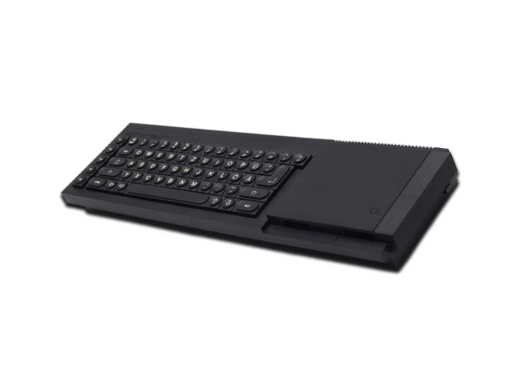
The Sinclair QL (Quantum Leap) was a computer developed and marketed by Sinclair Research, a company founded by British entrepreneur Sir Clive Sinclair, and released in 1984. The Sinclair QL differed significantly from the company’s popular ZX Spectrum; it was aimed at more serious users, such as small businesses and technically oriented hobbyists. Although the QL was technically innovative, it suffered from a number of problems that limited its commercial success.

Sinclair Research had achieved enormous success in the early 1980s with the ZX Spectrum, a low-cost home computer. Inspired by the commercial success of the Spectrum, Clive Sinclair decided to expand his company’s product line and target a broader market, particularly small businesses and advanced users. The Sinclair QL was unveiled in January 1984. Its name, Quantum Leap, reflected the company’s ambition to make a huge leap forward in the computer market. The rush to launch resulted in a half-finished product, which led to problems. The Sinclair QL was manufactured in the UK. Inexpensive components were used in the design to keep costs down, which was Sinclair Research’s strategy. This was evident in both the technical choices made for the computer and its plastic casing. The goal was to sell the device for less than £400, which was significantly less than competing computers. The Sinclair QL incorporated many advanced technologies of the time that made it a competitive computer, such as the Motorola 68008 processor, which was a cheaper and lighter version of the Motorola 68000 processor. The processor ran at a clock speed of 7.5 MHz. It came standard with 128 kilobytes of RAM, which could be expanded to up to 640 kilobytes. The storage medium was a Microdrive, which used fast but unfortunately unreliable tape cassettes for data storage. QL supported two video modes: either a 256 × 256 pixel graphics mode with 8 colors, or a more limited 512 × 256 pixel mode for word processing. The operating system was QDOS, Sinclair’s own operating system.

Sales figures for the Sinclair QL were disappointing, especially when compared to the company’s previous successful products. It is estimated that between 150,000 and 200,000 units were sold during its lifetime. This was significantly less than the sales figures for the Commodore 64 or ZX Spectrum, for example, which sold in the millions. The QL was most popular in the UK, which was Sinclair Research’s home market. Elsewhere in Europe, the device received a mixed reception, and in the US, the QL failed to gain a foothold, as the market there was already strongly dominated by the Apple II and IBM PC. At the time of its release, the Sinclair QL cost around £399 in the UK, which was significantly less than most other 16/32-bit computers. However, the price was still too high for many home users, who preferred cheaper home computers. In Finland, the price of the device settled at around 5,000–6,000 marks. The Sinclair QL was an ambitious but unfinished product that attempted to fill two market niches – the business sector and the hobbyist market – without fully succeeding in either. Although it did not achieve great commercial success, its memory lives on strongly among hobbyists. The Sinclair QL has been featured in various computer exhibitions, such as I love 8-bit®, which showcases the history of computers and consoles from the 1980s. The QL’s unique history and technical innovations have made it an interesting collector’s item.


Sinclair ZX Spectrum +3

Sinclair ZX Spectrum +3
The Final Chapter with a Touch of James Bond

By the end of the 1980s, Sinclair Research had established the ZX Spectrum as the cornerstone of the home computer market in the UK and parts of Europe. Its affordable price and versatile software library had made it a cultural icon. In 1987, Sinclair introduced the ZX Spectrum +3, the last official model in the Spectrum series, which marked both the evolution of the platform and an attempt to appeal to a broader and more demanding customer base. Its graphics capabilities remained consistent with the Spectrum family, offering 256×192 pixels and a 15-color palette, but the machine’s expanded memory allowed for more sophisticated software. This made the +3 an attractive option for previous Spectrum owners looking to upgrade within the product family.

One of the most notable features of the ZX Spectrum +3 was its marketing. Sinclair sought to improve the device’s image by linking it to popular culture and glamour, most notably with a James Bond-themed advertising campaign. The marketing campaign linked the Spectrum +3 to the sophistication and excitement of the Bond series by presenting the computer as stylish and advanced. The advertisements presented the +3 not only as a tool for enthusiasts, but also as a sophisticated home computer suitable for both serious data processing and entertainment, with the aim of capturing the imagination of teenagers and families. This approach reflected Sinclair’s recognition that the home computer market was maturing and that consumers were increasingly interested in machines that combined technical expertise with attractive looks.

Gaming on the +3 remained a major attraction. The device was compatible with most of the existing Spectrum software library, ensuring that classic games such as Manic Miner, Jet Set Willy, and Sabre Wulf could still be played. In addition, the +3’s disk drive enabled the development of new and improved games that took advantage of the additional memory and storage capacity. Gamers and computer enthusiasts appreciated the combination of backward compatibility and forward-looking design, which meant they could enjoy their old favorites while also exploring new software that took advantage of the platform’s capabilities. In addition to entertainment, the ZX Spectrum +3 was also suitable for productivity and educational applications. The fast storage provided by the disk drive allowed users to use word processors, spreadsheets, and programming environments more efficiently than on tape-based systems. The machine’s BASIC interpreter remained a core feature, allowing novice programmers to experiment with code, create software, and learn basic computer skills. The software was easier to manage and use thanks to the reliability of the diskettes, which reinforced the Spectrum’s long-term role in promoting computer skills among students and hobbyists. Critics of the +3 pointed out that, although it was an improvement on previous models, some limitations of the Spectrum architecture remained. The graphics and sound were still modest compared to the 16-bit machines of the time, such as the Amiga or Atari ST. The Z80 processor was unable to compete with the more powerful computers that entered the market in the late 1980s. Nevertheless, the +3 was praised for its thoughtful improvements, particularly the built-in disk drive and redesigned keyboard, which addressed the two most significant complaints users had about previous models. Its James Bond-themed marketing also set it apart from its competitors by combining technical improvements with cultural appeal, creating a machine that felt modern, ambitious, and fun.

The Spectrum +3 was well received by both enthusiasts and new users. Gamers and software developers in particular appreciated the device’s compatibility with earlier Spectrum models. Its expanded memory and improved storage solutions were praised. The combination of entertainment, programming possibilities, and practical applications made the +3 a versatile and improved platform, even though more powerful 16-bit machines were entering the market. Its marketing, which linked the product to the glamour of James Bond, improved its image in a humorous way. Ultimately, the ZX Spectrum +3 represents the final evolution of Sinclair’s popular 8-bit platform. It combined the appeal of the original Spectrum with significant improvements, such as disk-based storage and a more comfortable keyboard, while adopting a marketing strategy that linked the technology to popular culture. By integrating these features, Sinclair succeeded in creating a machine that honored the legacy of the ZX Spectrum family, appealed to both dedicated fans and new users, and proved that even at the end of an era, the Spectrum could remain relevant, innovative, and exciting. The +3 is further proof of Sinclair’s ability to develop the Spectrum further, and it also demonstrated the faith that its manufacturer, Amstrad, had in the Spectrum product family.


Commodore Plus 4

A misstep in the
home computer market by Commodore

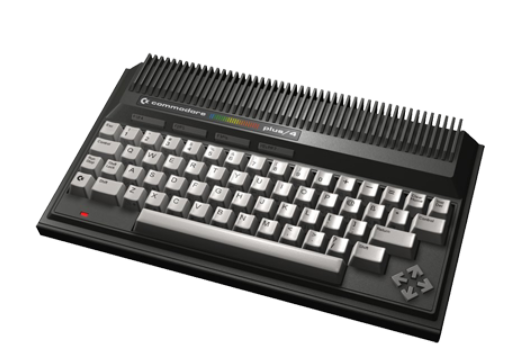
The history of personal computing in the 1980s is filled with both groundbreaking successes and notable miscalculations. One of the more fascinating case studies in this regard is the Commodore +4, a machine that attempted to bridge the gap between home and business computing but ultimately struggled to find a lasting place in the market. Although remembered as part of the broader Commodore 264 series, the +4 is significant in its own right as a product of both high ambition and flawed execution. The Commodore +4 was officially introduced at the 1984 Summer Consumer Electronics Show (CES)in Chicago. Commodore announced it as the centerpiece of the new 264 series, which also included the Commodore 16 and Commodore 116. The “+4” name referred directly to one of its most publicized selling points: four built-in productivity applications. These were a word processor, a spreadsheet, a database, and a simple graphics program. Commodore envisioned this as a way to appeal not only to the home market but also to small businesses and budget-conscious professionals. At launch, the Commodore +4 carried a price tag of around \$299 USD, which was lower than the Apple IIe or IBM PC Jr. but higher than the extremely successful Commodore 64, which was available at under \$200 by late 1984 due to aggressive price wars. Commodore hoped to position the +4 as a middle ground: inexpensive compared to business machines, but more productivity-focused than purely entertainment-oriented home computers.

There were not much room for Commodre +4 model since the Commodore 64 already dominated the home computer markets with a large and rapidly growing software library. The Apple II entrenched in education and small business environments. The Sinclair ZX Spectrum, especially in Europe, which delivered cheap home entertainment. The Amstrad CPC series offered an affordable all-in-one design in Europe with a growing software ecosystem. Against such competition, the +4 was caught in an awkward position. Yes, the Commodore +4 was not imported officially into Finland. In fact, the entire 264 series saw just few releases in several Nordic countries. However, much like in other markets, its reception was lukewarm. Finnish users, like those elsewhere, gravitated more toward the Commodore 64 and later the Amiga, leaving the 264-series including Commodore +4 as a curiosity rather than a mainstream success.

The Commodore +4 contained several unique features, both positive and problematic. There was a built-in office Suite in +4. There were four applications (word processor, spreadsheet, database, and graphics) were meant to provide immediate utility out of the box. Unfortunately, they were underpowered and could not rival dedicated software available on other platforms. The processor was MOS Technology 7501 CPU that was a variant of the 6502. It was clocked at 1.76 MHz, delivering slightly faster performance than the C64. There were improved BASIC (Commodore BASIC 3.5) that offered advanced commands for graphics and sound programming, making it easier to exploit hardware features. Sound was maybe the greatest weakness of Commodore +4. Instead of the celebrated SID chip in the C64, the +4 relied on a simple two-voice sound generator, widely criticized as inadequate for gaming. This was done to reach cost efficiency manufacturing process, because Commodore wanted compete particularly against Japanese manufacturers. Despite its limited popularity and modest sound chip, the +4 did attract a modest library of games. Most were adaptations of titles that existed on the C64 or Spectrum. The most consistent supporters of the platform were Kingsoft, Mastertronic, and Commodore’s own publishing arm, but overall, the +4’s software catalog was shallow compared to its competitors.

Exact sales figures are debated, but estimates suggest the Commodore +4 sold fewer than one million units worldwide, compared to the 17 million units of the Commodore 64. While the +4 saw some traction in parts of Eastern Europe (particularly Hungary, where local developers embraced it for educational and hobbyist purposes), in Western markets it was largely regarded as a commercial failure. Contemporary reviews of the +4 were mixed to negative. Technology magazines praised its affordable price and noted that the improved BASIC was easier to use for beginners than the older Commodore 64’s version. However, they also emphasized its glaring weaknesses like incompatibility with the Commodore 64. That was perhaps the most criticized flaw. Given the C64’s enormous software base, the lack of backward compatibility meant the +4 started with a near-empty library. Reviewers repeatedly noted the downgrade from the SID chip to the rudimentary two-voice sound. Marketed as a selling point, the “+4” office suite was widely dismissed as too limited for serious business use. Magazines described the machine as “a solution in search of a problem,” and many journalists speculated that it existed primarily because Commodore’s new management wanted to distance itself from Jack Tramiel’s product vision after his departure.

The Commodore +4 represents a bold but flawed experiment in the home computer era. Introduced in 1984 at the Chicago CES, it was positioned as a productivity-oriented but low-cost alternative to both business machines and game-focused home computers. Its built-in office suite, colorful graphics, and enhanced BASIC were notable innovations, but these were overshadowed by its lack of C64 compatibility, weak sound hardware, and insufficient software library. Although it sold fewer than one million units and was quickly eclipsed by the continuing success of the Commodore 64 and the rise of the Amiga, the +4 remains a fascinating artifact. It illustrates both Commodore’s ambitions to dominate every tier of the computing market and the risks of misjudging consumer expectations. Today, the +4 is remembered less for its commercial success and more as a symbol of the volatile and experimental nature of the 1980s microcomputer boom.

Salora Manager

Salora was the computer in borrowed plumes

In the early 1980s, home computers flooded the world at an accelerating pace. One interesting step of the early computer era was the Salora Manager. It was a home computer that was not technically Finnish, but was sold under a Finnish brand name. Salora Manager was the Finnish version of the VTech Laser 2001 computer and offered consumers an affordable gateway to the world of information technology shortly before the Commodore 64 and MSX standard became widespread. The idea was quite clever. Many households had Salora radios and televisions, which had a good reputation and an existing distribution network in Nordic countries. So why not offer to consumers Salora home computers as well, the Salora marketing department must have thought. The project was launched, and the devices were named Salora Fellow and Salora Manager.

Salora Manager used a BASIC interpreter developed by Microsoft. Programs were loaded from C cassettes, but a 5.25-inch floppy disk drive was also available. There were also a few cartridge games, such as Auto Chase. The cassette drive was not built-in, but connected separately – often using a standard home stereo cassette player. The machine’s user interface opened into the BASIC development environment. Users could write programs and draw graphic patterns, for example. A small selection of games and programs was released for the Salora Manager. Since the device was based on the VTech Laser 2001, all of its programs worked on the Salora Manager – either on cassette or manually coded through the BASIC interpreter.

Salora Manager was obviously targeted at beginners and families who wanted an affordable way to get acquainted with computers. It was also a teaching tool and a platform for programming practice, rather than a gaming machine. Salora Manager failed to establish itself as the home computer market developed and quickly consolidated around a few options. In 1984–1985, it was overtaken by technically superior machines with a wider range of games, such as the Commodore 64 and MSX devices. The Salora Manager had a short life cycle, but it fulfilled its purpose in introducing Finns to information technology. Today, the Salora Manager is part of Finland’s information technology history. It is particularly valued as a domestic brand and a symbol of the spirit of the times. In retro collections, the machine is an interesting curiosity – a reminder of a time when information technology was still new, exciting, and somewhat experimental. Salora Manager was part of the global VTech company, but in Finland it gained its own identity. It brought affordable home computers to Finnish homes at a time when computers were not yet commonplace. Salora Manager is an important part of the traveling I love 8-bit® computer exhibition organized by the Kallio Computer Museum, where visitors can try out the device. A few years after Salora Manager, Nokia began its global conquest with its own mobile phone products. Despite the modest background, Finns were able to to develop world-class consumer products in information technology just few year after the unlucky Salora Computers.


Salora Manager and Vtech platform for home computers

In the early 1980s, the personal computer market was fragmented, experimental, and deeply shaped by national and regional conditions. While global brands such as Commodore, Sinclair, and Atari dominated headlines, a parallel ecosystem of licensed, rebranded, and locally marketed computers emerged across Europe and Asia. One of the most illustrative examples of this phenomenon was the VT Laser 2001, a computer that stood at the intersection of Asian manufacturing, British-inspired design, and European consumer electronics branding. In Finland, the machine became known as the Salora Manager, a name that reflected both its local distributor and its intended role as a serious, practical home computer.

The VT Laser 2001 was manufactured by Video Technology Ltd. (VTech), a Hong Kong–based company that would later become globally recognized for educational electronics. The Laser 2001 was introduced around 1983 as part of VTech’s broader Laser series, which included related models such as the Laser 110, Laser 210, and Laser 310. These systems shared a common technical foundation but differed in memory configuration, keyboard quality, and expandability. The Laser 2001 occupied a mid-range position within this family, offering more capability than entry-level models while remaining affordable. In Finland, the computer was marketed as the Salora Manager, distributed by Salora, a well-known domestic electronics company primarily associated with televisions and radio equipment. This rebranding strategy was common at the time, allowing local manufacturers to participate in the growing home computer market without developing an entirely new platform. By offering the Laser 2001 under the Salora name, the system gained instant credibility among Finnish consumers, who associated the brand with reliability and local support. Outside Finland, the same hardware appeared under various names depending on the distributor, reinforcing the Laser 2001’s identity as a regionally adapted computer rather than a globally unified platform.

Technically, the VT Laser 2001 was based on the Zilog Z80 CPU, running at approximately 3.25 MHz. It typically shipped with 16 KB or 32 KB of RAM, with ROM containing a Microsoft-derived BASIC interpreter. Graphics capabilities were modest but functional, offering a resolution of 256×192 pixels with a limited color palette, broadly comparable to early Sinclair machines. Sound output was minimal, relying on a simple internal speaker capable of basic tones. Software was loaded primarily from cassette tapes, reflecting the system’s cost-conscious design and the technological norms of the period. The operating environment was deliberately simple. On startup, users were presented directly with a BASIC prompt, encouraging experimentation, learning, and programming. There was no complex operating system in the modern sense; instead, the Laser 2001 emphasized immediacy and transparency. This made it particularly suitable for educational use, a role strongly emphasized in Salora’s marketing. Schools and families were encouraged to see the Manager not merely as a gaming device, but as a tool for learning programming, logic, and the fundamentals of computing.

Contemporary press coverage of the Salora Manager and VT Laser 2001 was measured and pragmatic. Finnish and European computer magazines generally praised the machine’s affordable price, solid construction, and comparatively good keyboard, which was often regarded as superior to the rubber-key designs of early ZX Spectrum models. Reviewers also noted that the system was approachable for beginners, particularly for BASIC programming. However, criticism was equally common. Journalists pointed to the computer’s limited graphics and sound, slow cassette loading, and relatively small software library when compared to dominant platforms like the Commodore 64. Despite these criticisms, the VT Laser 2001 was important within its context. In countries like Finland, where imported home computers were expensive and not always well supported, the Salora Manager offered a locally branded alternative that lowered the barrier to entry. For many users, it was a first exposure to computing—typing BASIC programs, loading simple games, and understanding how software interacted with hardware. In this sense, the Laser 2001 fulfilled a crucial transitional role similar to that played by the ZX Spectrum in the UK or the VIC-20 elsewhere.

The machine also exemplified the globalization of early home computing. Designed and manufactured in Asia, inspired by British 8-bit architectures, and sold under European brand names, the Laser 2001 demonstrated how computing technology crossed borders long before full international standardization emerged. This approach enabled rapid market entry but came at the cost of long-term cohesion. Software ecosystems were fragmented, upgrades were limited, and users were often locked into platforms with short commercial lifespans.

  • In Finland, the basic Z80-based model (Laser 200) was sold as the Salora Fellow, while the 6502-based successor (Laser 2001) became the Salora Manager.
  • In Hungary and Italy, the same Laser 200 hardware was marketed as the Seltron 200, albeit in relatively small numbers compared to other markets.
  • In the United Kingdom, the Laser 200 appeared as the Texet TX8000A.
  • In Australia and New Zealand, it was branded as the Dick Smith VZ200.
  • In North America (United States and Canada), VTech sold it under its own name as the VTech VZ 200.

The limitations of the VT Laser 2001 eventually became insurmountable. As expectations shifted toward disk drives, richer sound, hardware sprites, and larger memory capacities, the Laser series struggled to compete. The absence of a strong, unified developer community further accelerated its decline. By the mid-1980s, attention had moved decisively toward machines such as the Commodore 64, Atari XL series, and later MSX computers, leaving the Salora Manager as a transitional artifact of an earlier phase. Today, the VT Laser 2001 and Salora Manager are remembered primarily by retro computing enthusiasts and collectors. Their significance lies not in technical breakthroughs, but in accessibility and localization. They represent a moment when home computing expanded beyond major technology hubs and entered smaller markets through adaptation and rebranding. The Laser 2001 may not have shaped the global industry, but it shaped individual experiences.


Memotech MTX-512

The home computer from Memotech:
It’s not MSX. It is MTX!

In the early 1980s, Britain became one of the most vibrant and competitive home-computer markets in the world. From the modest ZX81 to the BBC Micro, personal computing in the United Kingdom was experiencing a golden age. Every few months, a new micro appeared on the shelves, promising to bring the future into the living room. Yet by 1984, that market was also beginning to strain under its own weight. Dozens of small companies entered the race, and just as quickly vanished when the public’s enthusiasm cooled or when giants such as Sinclair, Commodore, and Amstrad tightened their grip. Into this volatile world came a company called Memotech Ltd., and with it, one of the most stylish and technically refined British home computers ever built: the Memotech MTX.

Memotech was not originally a computer manufacturer. Founded by Geoff Boyd and Robert Branton in Oxfordshire, the company gained early success producing high-quality RAM expansions for the Sinclair ZX81, a machine famous for its affordability but equally notorious for its limitations. Memotech’s metal-cased expansions were praised for their reliability and design, and soon the firm decided that it could build an entire computer to the same standard. What emerged was the MTX series—machines that would stand out for their professional appearance, strong build quality, and advanced specification for the time.

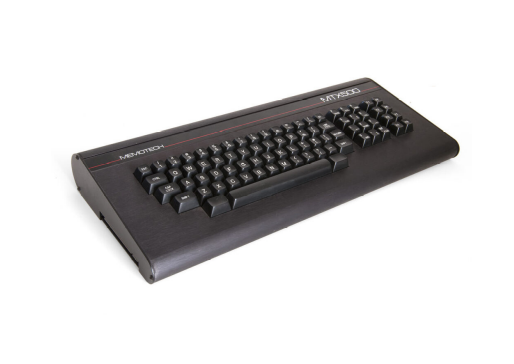
The first model, the MTX 500, appeared in mid-1983, followed soon by the MTX 512 and later the RS128. All shared the same elegant black brushed-aluminum case, a far cry from the plastic shells of most of their rivals. Inside, the machines ran on a Zilog Z80A processor clocked at 4 MHz, with either 32 KB or 64 KB of RAM. Their Texas Instruments video chip could display 256 × 192 graphics, sixteen colours, and up to thirty-two hardware sprites—capabilities that compared favourably to the contemporaneous ZX Spectrum and even challenged the newer MSX machines. Sound came from the SN76489A chip, offering three tones and noise. The keyboard was full-sized, with eighty keys and a solid mechanical action that felt almost luxurious. In an era when rubber chiclets and wobbly keys were common, the MTX looked and felt like a serious instrument.

Technically, the MTX was versatile. Its expansion ports allowed the attachment of disk drives, serial and parallel interfaces, and even the running of the CP/M operating system through an external module called the FDX. That meant business software such as WordStar or dBase could, in principle, run on a home machine. The built-in BASIC interpreter, stored in ROM, was powerful and included commands for graphics and sound that made the machine friendly to programmers. Memotech clearly wanted to straddle both the hobbyist and professional markets—appealing to the home user who enjoyed games and coding, but also to schools and small businesses seeking a capable yet affordable CP/M system.

Yet the MTX entered the market at a perilous time. The British micro boom was beginning to falter. The public that had enthusiastically bought computers in 1982 and 1983 was now more cautious, and retailers were flooded with unsold stock. Commodore had driven prices down with the VIC-20 and later the dominant Commodore 64, while Amstrad was preparing to launch its integrated CPC 464 at an aggressive price. The MTX, with its premium metal case and full-sized keyboard, inevitably cost more—around £275 at launch for the 32 KB model. For many families, that was a difficult proposition when cheaper and better-supported alternatives existed.

Software support proved to be the decisive weakness. Despite its technical strengths, the MTX arrived without a strong base of games or educational titles, and developers were reluctant to commit to another new platform. Memotech hoped that compatibility with the emerging MSX standard might help, but the MTX ultimately differed just enough to make direct software sharing impossible. Without the ability to run Spectrum or Commodore programs, and lacking an MSX badge, it occupied an awkward no-man’s-land between standards. A few good titles appeared—Attack of the Mutant Camels, Kilopede, and Flight Simulator among them—but they were not enough to establish a thriving ecosystem.

Still, for the small number of users who did buy one, the MTX was a delight. Programmers appreciated the machine’s fast BASIC and the ability to write in assembler using the built-in monitor. The graphics and sound chips offered creative potential, and the solid keyboard made it a pleasure to type on. The optional FDX system, with its twin floppy drives and CP/M compatibility, turned the MTX into a credible small-business computer. In educational settings, it offered durability and expandability. There was a sense among enthusiasts that the MTX was a machine for those who cared about quality rather than fashion—a connoisseur’s choice.

Unfortunately, quality alone could not save it. Memotech invested heavily in production facilities, expecting large sales volumes that never materialized. The company also pursued ambitious export deals, including a proposed contract to supply computers to Soviet schools, but the political and logistical complexities of the Cold War scuttled the plan. By 1985, unsold stock piled up, and the firm was forced to slash prices drastically: the MTX 500 fell to under £80 in some clearance sales. Not long afterward, Memotech went into receivership. Production of the MTX line ceased, and the remaining inventory gradually disappeared from the market.

In hindsight, the Memotech MTX’s failure was not due to poor engineering but to timing and market realities. By 1984, consumers were increasingly driven by price and software libraries rather than by hardware elegance. The ZX Spectrum dominated the home-gaming market through sheer volume and developer support. The BBC Micro had captured the education sector. Commodore and Amstrad were fighting over the mainstream, leaving little room for a stylish outsider. Even in business computing, the CP/M niche was rapidly being replaced by IBM-compatible PCs. The MTX was a machine caught between worlds: too refined and expensive for the casual user, too small and incompatible for the business world.

Yet for all its commercial disappointment, the MTX left a mark on computing culture. Collectors today still admire its craftsmanship, the smoothness of its keyboard, and the understated beauty of its aluminum shell. In many ways, it symbolized what was best about the British microcomputer era: a spirit of engineering ambition, a willingness to innovate, and a belief that personal computing could be elegant as well as accessible. Though only a few tens of thousands were ever sold, the MTX remains a favourite among retro-computer enthusiasts who see in it the road not taken—the idea that a British machine could compete on quality, not just price.

The story of Memotech and its MTX computers is, in the end, both inspiring and tragic. It demonstrates how talent and vision can produce remarkable technology, yet also how unforgiving the marketplace can be. The MTX stood proudly among the crowded ranks of 1984’s home computers, its metal gleaming where others offered brittle plastic, but when the dust settled, it was the mass-market machines that survived. Memotech disappeared by 1985, leaving behind only the memory of a beautifully built machine that arrived just a little too late and cost just a little too much.

Today, when one powers up a surviving MTX and sees its clean blue screen flicker to life, it is easy to imagine what might have been. In a time when computing was still an adventure, the Memotech MTX represented both the dream of perfection and the reality of the marketplace. It is a reminder that technology’s history is written not only by the winners, but also by the elegant, doomed machines that dared to compete.

Atari XEGS

The last 8-bit endeavor from Atari

By the mid-1980s, the home-computer and videogame-console markets were undergoing significant change. The dramatic crash of the videogame market in the United States beginning in 1983 underscored how saturated the market had become and how difficult it was for incumbents to revive growth. Meanwhile, the 8-bit home-computer market (machines like the Atari 800XL, the Commodore 64, and others) was seeing both its heyday and the first signs of transition to next-generation systems. Into this environment stepped Atari (via its incarnation as Atari Corporation after the company restructure under Jack Tramiel) with the XEGS in 1987. The goal was to blend the worlds of videogame console and home computer, offering compatibility with the existing Atari 8-bit computer line while presenting a more console-oriented form for families and gamers.

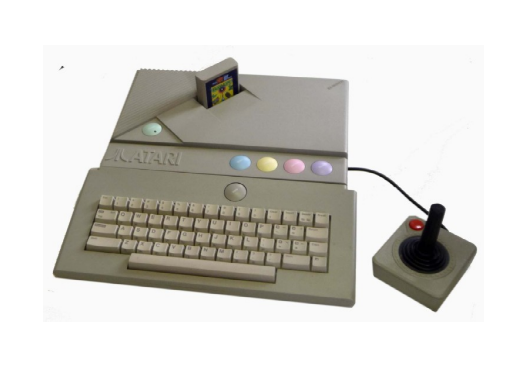
The Atari XEGS (Atari XE Video Game System) was essentially a redesign of the Atari 65XE home computer (part of the XE family) packaged as a games console with the optional addition of a keyboard to convert it into a fully capable Atari 8-bit computer. It was released in 1987.The machine used a MOS 6502C (often 1.79 MHz NTSC or 1.77 MHz PAL) CPU, 64 KB of RAM (onboard) and ran the familiar Atari 8-bit architecture: chips like ANTIC and GTIA for graphics, POKEY for sound. For media, it used cartridge format and also accepted most of the older Atari 8-bit software and hardware — hence it could in theory serve as both console and computer. One key packaging variant was the “basic” set (console + joystick) and the “deluxe” set (console + joystick + detachable full-keyboard + XG-1 light-gun).

Sales and production figures

Exact global sales figures for the XEGS are somewhat elusive and inconsistent. One credible data point is that Atari sold approximately 100,000 XE Game Systems during the Christmas 1987 launch period, a figure described as “every unit produced during its launch window”. Some other sources note that overall support and new game releases tapered off after 1988, and that the 8-bit line (including the XEGS) was discontinued by Atari by early 1992.One source suggests that the XEGS did not feature at all in Atari’s annual reports after 1990, implying limited ongoing production. Therefore, while the 100,000 units number gives a snapshot for the launch, the total lifetime sales figure may have been somewhat higher but still modest compared with major console players of the time.

What the press and magazines wrote, positives and negatives

Contemporary and retrospective commentary on the XEGS emphasised a mix of promise and limitations. On the positive side, reviewers appreciated that the XEGS offered a dual-mode device: for users who wanted a console (plug in, joystick, game) it served that, while for those willing to attach the keyboard it became a full home computer with the rich Atari 8-bit software and peripherals. For example, one reviewer called the combination “a brilliant idea” for users who “didn’t have the foggiest idea what to do with a computer … [but] would have no compunction about buying a great video-game system”. In hardware terms, the leveraging of the existing 8-bit Atari architecture meant that compatibility (in many cases) with prior software/hardware was possible, and the detachable keyboard allowed a low-entry price for console buyers.

On the negative side, the press and analysts were critical of several aspects. Despite claims of compatibility, not all older Atari 8-bit cartridges and peripherals ran 100% smoothly on the XEGS — some games required translation or did not run as expected. Some are full-disk games that take anywhere from 1-4 disks … the end result is that games like ‘Astro Chase’ … won’t run on an XEGS system.” The hardware itself was already somewhat dated by launch: the architecture was essentially mid-early 1980s technology being pushed in 1987. The software library and developer support were weak compared to major competitors — few new flagship games were developed specifically for the XEGS. One source notes that after 1988 there were virtually no new releases. Marketing seemed under-whelming and the console/computer duality may have generated confusion in the market: Was this a console for games, or a computer for hobbyists? Neither message was pushed strongly enough to differentiate. In console form the XEGS lacked the cachet and ecosystem of leading rivals such as the Nintendo Entertainment System (NES). Some hardware aspects such as the light-gun (XG-1) were judged sub-par in accuracy. Thus, while the XEGS held conceptual appeal, execution and market timing limited its impact.

Atari XEGS – the reasons to get one 1980’s

As a plug-in console with joystick, for families seeking an affordable gaming system with some pedigree (Atari brand) and a library of immediately playable cartridges. As a “starter computer” for households where the idea of a keyboard and programming hobby appealed, but full computer systems (dedicated home computers) seemed more expensive or complex. Because the XEGS could remain a console but later be expanded by adding the keyboard, it offered flexibility. For users already owning Atari 8-bit software/hardware, the XEGS offered backward compatibility and a convenient way to reuse existing cartridges, peripherals and cassette/disk drives. For educational purposes: the full computer mode (with keyboard) provided access to programming (Atari BASIC Revision C) and the wide range of educational software developed for the Atari 8-bit line. In markets where new console options were expensive and older 8-bit machines were still viable, the XEGS might have offered good value.

The lifespan of the XEGS was relatively short. Although released in 1987, support and production of the Atari 8-bit line (including the XEGS) was officially discontinued by December 1991. After that date, the XEGS was no longer actively supported and became effectively obsolete in the face of 16-bit machines and emerging console generations. One retrospective source notes that the system “did worse than the Atari 7800 … and was yet another instance of Atari failing to save itself from Nintendo’s increasingly domineering presence.” In effect, the XEGS occupies a transitional niche: a late 8-bit Atari product that tried to straddle the console-and-computer boundary but ultimately did not secure a large market share or long lifespan.

Competition and market context

When the XEGS launched in 1987, the competitive environment was formidable. On the console side, Nintendo’s NES dominated the market in many territories. On the computer side, 16-bit home computers (e.g., the Atari ST line, the Commodore Amiga) were beginning their rise. The Atari XEGS had to compete not only with dedicated consoles offering strong marketing and fresh libraries, but also with home computers offering more advanced capabilities for programming, graphics and higher memory. In addition, the fact that the XEGS was architecturally tied to older 8-bit technology meant it lacked the “wow factor” of newer machines and thus struggled to differentiate. Thus, the XEGS’s competitive disadvantage stemmed from being both too late to the console race and too modest compared to emerging computers.

Legacy

Though the Atari XEGS was not a major success, it remains of interest to retro-computing and retro-gaming enthusiasts. It represents a “bridge” model — a home console built from a home computer architecture and intended for both gaming and computing. The fact that it is compatible with the wider Atari 8-bit ecosystem gives it a broad software base for hobbyists. For many collectors, the XEGS (especially in its deluxe keyboard + light-gun bundle) is a notable piece of Atari history and a symbol of the company’s efforts to reposition itself in the late 1980s. While the machine did not turn the tide for Atari, it is remembered as a bold if flawed attempt to straddle multiple market segments at once.

The Atari XE Game System (XEGS) was introduced in 1987 as an attempt by Atari Corporation to merge the worlds of console gaming and home computing, leveraging its existing 8-bit computer architecture (the XE line) in a new form factor. While it offered flexibility, compatibility and reasonable hardware for the era, it suffered from outdated technology, weak software support, and fierce competition from both dedicated consoles and emerging home computers. Although launch-sales of around 100,000 units indicate some initial interest, the limited lifespan (discontinuation by ~1991) and modest impact on the market underscore its niche status. For users seeking an affordable console or introduction to computing in the late 1980s, the XEGS may have made sense—but in the evolving landscape of videogames and computers its capabilities were already somewhat behind the curve. Nonetheless, in retrospect it serves as an interesting footnote in Atari’s history and the creative cross-pollination of console and computer design.

Popular games 

Here are some games presented that were popular on Atari XE.

Boulder Dash
Bug Hunt (light gun)
Dig Dug
Donkey Kong
Flight Simulator II
Frogger
Pac-Man
Pitfall!
River Raid
Zaxxon


Atari Jaguar

The story of a 64-bit Atari Jaguar
The dream that flopped

In the annals of video game history, few consoles embody the paradox of ambition and failure as clearly as the Atari Jaguar. Marketed boldly as the world’s first “64-bit” gaming console, the Jaguar aimed to re-establish Atari as a major force in the gaming industry during the early 1990s. But despite promising technology and nostalgic brand power, the Jaguar ultimately became one of gaming’s most infamous commercial failures. By the late 1980s, Atari Corporation, led by Jack Tramiel, was a diminished shadow of its former self. Once dominant in both home computers and gaming consoles, Atari had failed to match the success of Nintendo and Sega in the lucrative home console market. Systems like the Atari 7800 had been largely ignored by consumers, and the company’s attempts to innovate with handhelds like the Atari Lynx had also struggled to capture a mainstream audience. Desperate to reassert itself, Atari pinned its hopes on a next-generation console that would leapfrog its competitors technologically: the Atari Jaguar.

Development of the Jaguar began in the early 1990s, under the codename Project Jaguar. Atari partnered with Flare Technology, a group of engineers, to design the new hardware. The goal was clear: create a system powerful enough to surpass the Sega Genesis and Super Nintendo Entertainment System (SNES), and ideally challenge upcoming 32-bit consoles like the Sony PlayStation and Sega Saturn.

Atari’s engineers developed an innovative architecture:

  • Two custom 32-bit processors, named “Tom” and “Jerry.” Tom handled graphics and video output, while Jerry focused on audio and co-processing tasks.
  • A Motorola 68000 CPU, the same processor used in the Sega Genesis and Atari ST, primarily tasked with handling control logic and compatibility.
  • Atari marketed the system as a “64-bit” console, arguing that the combined capabilities of the two 32-bit processors justified the label. This claim was heavily disputed, but Atari insisted the architecture offered genuine 64-bit performance.

The console used ROM cartridges for media, eschewing the CD-ROM trend, although a Jaguar CD peripheral would be released later.

Release and Market Launch

The Atari Jaguar was officially launched in November 1993 in select markets in the United States. Priced at $249.99, it was competitively priced compared to the SNES and Genesis. The initial rollout was limited, focusing on major urban centers before expanding nationally.

Atari heavily promoted the Jaguar’s “64-bit” architecture as its key differentiator. However, at launch, the Jaguar suffered from a critically small library of titles. The initial batch of games included:

  • Cybermorph (bundled with the console)
  • Trevor McFur in the Crescent Galaxy
  • Raiden (an arcade port)

While Cybermorph demonstrated 3D graphics beyond what SNES and Genesis could produce, critics found the gameplay repetitive and the visuals unimpressive for a “next-gen” system.

Press Reception: Hype Meets Skepticism

The press initially covered the Jaguar with cautious optimism. Atari’s bold claims attracted attention, and the prospect of a “64-bit” console intrigued consumers in an industry dominated by 16-bit systems.

However, reviews quickly turned critical:

  • The Jaguar’s unique architecture proved difficult to program. Developers often relied on the underpowered 68000 processor instead of exploiting the dual custom chips, leading to underwhelming performance.
  • Game libraries remained thin, and key titles were delayed.
  • The graphical leap was inconsistent: while 3D polygon graphics were possible, many games used 2D sprites, leading to comparisons with 16-bit systems rather than next-generation rivals.

Many reviewers began to view Atari’s “64-bit” claims as a marketing gimmick rather than a technological reality.

Despite an aggressive marketing campaign, the Jaguar struggled to gain traction:

  • In 1993, only around 17,000 units were sold.
  • By 1994, as availability expanded, sales increased, but not enough to challenge Nintendo or Sega.
  • In total, Atari sold approximately 150,000 to 250,000 Jaguar units globally during its lifespan.

In comparison, the SNES and Genesis each sold tens of millions of units.

In an attempt to address the limitations of cartridge media, Atari released the Jaguar CD peripheral in 1995, priced at $149.99. This add-on allowed the Jaguar to play CD-based games and offered multimedia features like CD audio playback. By 1996, Atari ceased production of the Jaguar and effectively exited the hardware business. Facing mounting financial losses, Atari Corporation merged with hard drive manufacturer JT Storage (JTS), marking the end of Atari as an independent gaming company. In 1998, Hasbro Interactive acquired the rights to the Atari brand. In 1999, Hasbro officially declared the Jaguar an “open platform,” allowing developers to create and distribute new software without licensing restrictions. This led to a small but dedicated homebrew community.

The Atari Jaguar remains one of gaming history’s most infamous failures — a case study in overpromising and underdelivering. Yet, its story is more nuanced:

  • Technologically, the Jaguar was ahead of its time in some respects, offering 3D graphics capability before the PlayStation and Saturn.
  • Its complex architecture hindered software development, a fatal flaw that limited its library and stifled third-party support.
  • Marketing missteps, poor game availability, and fierce competition doomed the console despite its potential.

Nevertheless, the Jaguar has earned a cult following among retro gaming enthusiasts. Titles like Tempest 2000, Alien vs. Predator, and Iron Soldier are fondly remembered as standouts on the platform.

The Atari Jaguar was both the final home console released by Atari and its final major attempt to reclaim its place in the gaming industry. Though it failed commercially, the Jaguar remains a testament to the company’s enduring spirit of innovation — even if that innovation was ultimately flawed. Today, the Jaguar symbolizes the end of an era. Atari, once a pioneer, exited the console market after the Jaguar’s failure, leaving the industry to companies like Sony, Nintendo, and Sega. But for a brief moment in the early 1990s,


es_ESEspañol