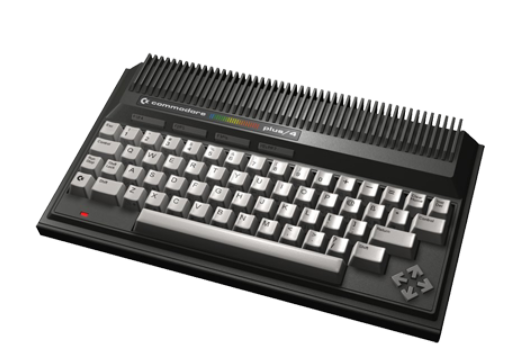
A misstep in the
home computer market by Commodore
The history of personal computing in the 1980s is filled with both groundbreaking successes and notable miscalculations. One of the more fascinating case studies in this regard is the Commodore +4, a machine that attempted to bridge the gap between home and business computing but ultimately struggled to find a lasting place in the market. Although remembered as part of the broader Commodore 264 series, the +4 is significant in its own right as a product of both high ambition and flawed execution. The Commodore +4 was officially introduced at the 1984 Summer Consumer Electronics Show (CES)in Chicago. Commodore announced it as the centerpiece of the new 264 series, which also included the Commodore 16 and Commodore 116. The “+4” name referred directly to one of its most publicized selling points: four built-in productivity applications. These were a word processor, a spreadsheet, a database, and a simple graphics program. Commodore envisioned this as a way to appeal not only to the home market but also to small businesses and budget-conscious professionals. At launch, the Commodore +4 carried a price tag of around \$299 USD, which was lower than the Apple IIe or IBM PC Jr. but higher than the extremely successful Commodore 64, which was available at under \$200 by late 1984 due to aggressive price wars. Commodore hoped to position the +4 as a middle ground: inexpensive compared to business machines, but more productivity-focused than purely entertainment-oriented home computers.
There were not much room for Commodre +4 model since the Commodore 64 already dominated the home computer markets with a large and rapidly growing software library. The Apple II entrenched in education and small business environments. The Sinclair ZX Spectrum, especially in Europe, which delivered cheap home entertainment. The Amstrad CPC series offered an affordable all-in-one design in Europe with a growing software ecosystem. Against such competition, the +4 was caught in an awkward position. Yes, the Commodore +4 was not imported officially into Finland. In fact, the entire 264 series saw just few releases in several Nordic countries. However, much like in other markets, its reception was lukewarm. Finnish users, like those elsewhere, gravitated more toward the Commodore 64 and later the Amiga, leaving the 264-series including Commodore +4 as a curiosity rather than a mainstream success.
The Commodore +4 contained several unique features, both positive and problematic. There was a built-in office Suite in +4. There were four applications (word processor, spreadsheet, database, and graphics) were meant to provide immediate utility out of the box. Unfortunately, they were underpowered and could not rival dedicated software available on other platforms. The processor was MOS Technology 7501 CPU that was a variant of the 6502. It was clocked at 1.76 MHz, delivering slightly faster performance than the C64. There were improved BASIC (Commodore BASIC 3.5) that offered advanced commands for graphics and sound programming, making it easier to exploit hardware features. Sound was maybe the greatest weakness of Commodore +4. Instead of the celebrated SID chip in the C64, the +4 relied on a simple two-voice sound generator, widely criticized as inadequate for gaming. This was done to reach cost efficiency manufacturing process, because Commodore wanted compete particularly against Japanese manufacturers. Despite its limited popularity and modest sound chip, the +4 did attract a modest library of games. Most were adaptations of titles that existed on the C64 or Spectrum. The most consistent supporters of the platform were Kingsoft, Mastertronic, and Commodore’s own publishing arm, but overall, the +4’s software catalog was shallow compared to its competitors.
Exact sales figures are debated, but estimates suggest the Commodore +4 sold fewer than one million units worldwide, compared to the 17 million units of the Commodore 64. While the +4 saw some traction in parts of Eastern Europe (particularly Hungary, where local developers embraced it for educational and hobbyist purposes), in Western markets it was largely regarded as a commercial failure. Contemporary reviews of the +4 were mixed to negative. Technology magazines praised its affordable price and noted that the improved BASIC was easier to use for beginners than the older Commodore 64’s version. However, they also emphasized its glaring weaknesses like incompatibility with the Commodore 64. That was perhaps the most criticized flaw. Given the C64’s enormous software base, the lack of backward compatibility meant the +4 started with a near-empty library. Reviewers repeatedly noted the downgrade from the SID chip to the rudimentary two-voice sound. Marketed as a selling point, the “+4” office suite was widely dismissed as too limited for serious business use. Magazines described the machine as “a solution in search of a problem,” and many journalists speculated that it existed primarily because Commodore’s new management wanted to distance itself from Jack Tramiel’s product vision after his departure.
The Commodore +4 represents a bold but flawed experiment in the home computer era. Introduced in 1984 at the Chicago CES, it was positioned as a productivity-oriented but low-cost alternative to both business machines and game-focused home computers. Its built-in office suite, colorful graphics, and enhanced BASIC were notable innovations, but these were overshadowed by its lack of C64 compatibility, weak sound hardware, and insufficient software library. Although it sold fewer than one million units and was quickly eclipsed by the continuing success of the Commodore 64 and the rise of the Amiga, the +4 remains a fascinating artifact. It illustrates both Commodore’s ambitions to dominate every tier of the computing market and the risks of misjudging consumer expectations. Today, the +4 is remembered less for its commercial success and more as a symbol of the volatile and experimental nature of the 1980s microcomputer boom.







 English (UK)
  Suomi
Suomi  Español