
The Computer That Educated a Generation:
Apple IIe
In the late 1970s, the personal computer industry was still in its infancy, dominated by hobbyist kits and small-scale electronics. Into this landscape stepped Apple Computer, a young company founded by Steve Jobs and Steve Wozniak in 1976. Their first machine, the Apple I, was a modest kit sold primarily to enthusiasts, but it laid the foundation for something far more ambitious. The **Apple II series**, introduced in 1977, would become one of the most influential lines of personal computers in history. Among its iterations, the **Apple IIe**, released in 1983, stands out as a symbol of refinement and longevity, combining technical improvements, ease of use, and software compatibility to solidify Apple’s foothold in homes, schools, and small businesses.

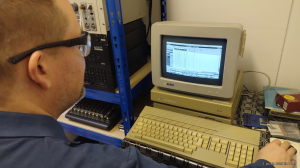
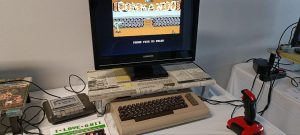
Classic Apple Computers in operation at the I love 8-bit® exhibition
The Apple IIe, short for “enhanced,” represented a thoughtful evolution of the Apple II architecture. It retained the familiar 8-bit **MOS Technology 6502 processor** running at 1 MHz but increased memory capabilities and added new features. The base model shipped with **64 KB of RAM**, expandable to 128 KB, and a new **built-in ASCII keyboard** replaced the earlier mechanical-switch design, offering a more comfortable typing experience. One of its most significant enhancements was the addition of **full ASCII character set support** and the ability to display both upper- and lowercase letters, which greatly improved readability and usability for word processing and programming. Graphics and sound capabilities were consistent with the earlier Apple II family, but incremental improvements made software more visually appealing and versatile.
The Apple IIe excelled in versatility, reflecting Apple’s understanding that personal computing was not a single-purpose activity. The machine could run **educational software**, business programs like **VisiCalc** and **AppleWorks**, and a growing library of games. Its **eight expansion slots** allowed users to add disk drives, memory boards, modems, and even third-party peripherals such as printers and joysticks. This modularity was particularly important in educational settings. Schools across the United States, and eventually in Europe and even Finland, embraced the Apple IIe because it could serve multiple purposes: a learning tool for programming, a platform for science and math simulations, and a gaming machine that engaged students in a fun way.
In Finland, the Apple IIe carved a niche among hobbyists, educational institutions, and tech enthusiasts. Local distributors provided access to both hardware and software, although availability was more limited than in the United States. Finnish computer clubs often used the Apple IIe for programming workshops and early networking experiments. Its BASIC interpreter encouraged a generation of programmers to explore coding fundamentals, while programs like **Logo** and **Oregon Trail** introduced students to problem-solving and simulation in an accessible way. In this sense, the Apple IIe was not merely a machine; it was a gateway into computing literacy at a time when digital skills were increasingly valued.
The press generally praised the Apple IIe for its durability, expandability, and compatibility with the extensive Apple II software library. Reviewers highlighted the comfort of its keyboard, the clarity of its graphics, and the broad ecosystem of applications as major strengths. Criticisms were relatively minor: the machine’s sound capabilities were limited compared to contemporary gaming-oriented consoles, and its price was higher than some 8-bit competitors. Still, for those willing to invest in a professional-quality home computer, the Apple IIe offered unmatched flexibility and long-term support.
The broader Apple II series, of which the IIe was a pivotal member, had a remarkably long life span. It began with the original **Apple II in 1977**, which established Apple as a company capable of producing a polished, ready-to-use home computer. The **Apple II Plus** followed in 1979, increasing memory and supporting Applesoft BASIC in ROM. The Apple IIe enhanced this architecture in 1983, while later models, including the **Apple IIc** and **Apple IIGS**, introduced portability and improved graphics and sound. Despite the rise of the Macintosh in the mid-1980s, the Apple II line remained in production for educational and business markets well into the early 1990s. Apple officially discontinued the Apple II series in **1993**, marking the end of an era that had begun with a simple wooden-case computer in a Silicon Valley garage.
Looking back, the Apple IIe exemplifies the strengths of Apple’s early approach: a machine designed for both versatility and reliability, capable of evolving while remaining compatible with a rich software ecosystem. Its influence extended far beyond homes and schools; it inspired a generation of programmers, entrepreneurs, and engineers who would go on to shape the digital world. The Apple IIe was more than a piece of hardware — it was a cultural and technological milestone that helped define the possibilities of personal computing.
In summary, the Apple II series, beginning with the original 1977 Apple II and culminating with the IIe and its successors, represents a remarkable chapter in computing history. It began as a hobbyist’s dream, matured into a professional and educational tool, and ended as a foundational legacy for Apple’s future innovations. The Apple IIe, in particular, symbolizes this evolution: a machine that combined technical competence, usability, and longevity, ensuring that the lessons and experiences it provided would resonate long after its production ended.








 English (UK)
  Suomi
Suomi  Español