
Salora was the computer in borrowed plumes
In the early 1980s, home computers flooded the world at an accelerating pace. One interesting step of the early computer era was the Salora Manager. It was a home computer that was not technically Finnish, but was sold under a Finnish brand name. Salora Manager was the Finnish version of the VTech Laser 2001 computer and offered consumers an affordable gateway to the world of information technology shortly before the Commodore 64 and MSX standard became widespread. The idea was quite clever. Many households had Salora radios and televisions, which had a good reputation and an existing distribution network in Nordic countries. So why not offer to consumers Salora home computers as well, the Salora marketing department must have thought. The project was launched, and the devices were named Salora Fellow and Salora Manager.
Salora Manager used a BASIC interpreter developed by Microsoft. Programs were loaded from C cassettes, but a 5.25-inch floppy disk drive was also available. There were also a few cartridge games, such as Auto Chase. The cassette drive was not built-in, but connected separately – often using a standard home stereo cassette player. The machine’s user interface opened into the BASIC development environment. Users could write programs and draw graphic patterns, for example. A small selection of games and programs was released for the Salora Manager. Since the device was based on the VTech Laser 2001, all of its programs worked on the Salora Manager – either on cassette or manually coded through the BASIC interpreter.

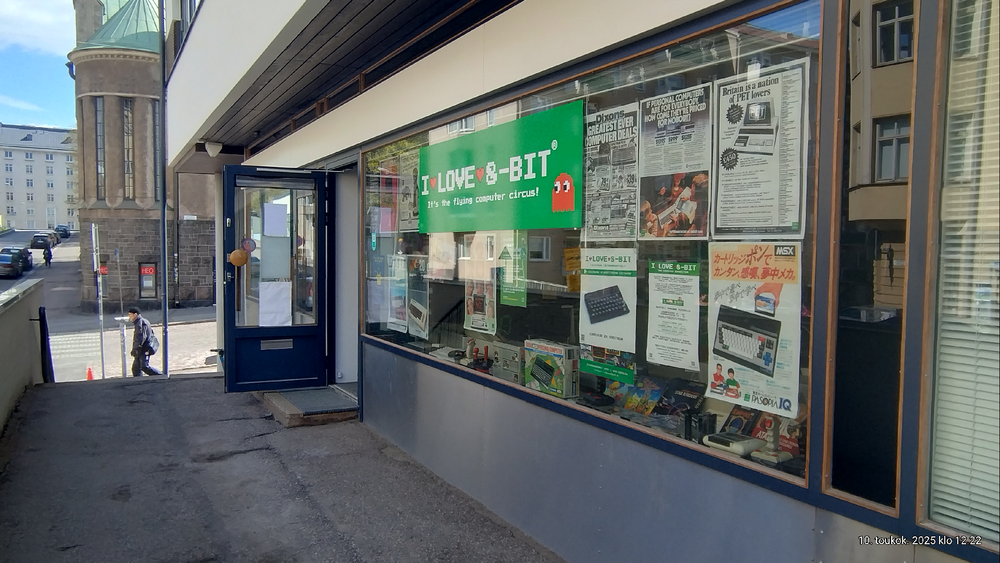
Salora Manager was obviously targeted at beginners and families who wanted an affordable way to get acquainted with computers. It was also a teaching tool and a platform for programming practice, rather than a gaming machine. Salora Manager failed to establish itself as the home computer market developed and quickly consolidated around a few options. In 1984–1985, it was overtaken by technically superior machines with a wider range of games, such as the Commodore 64 and MSX devices. The Salora Manager had a short life cycle, but it fulfilled its purpose in introducing Finns to information technology. Today, the Salora Manager is part of Finland’s information technology history. It is particularly valued as a domestic brand and a symbol of the spirit of the times. In retro collections, the machine is an interesting curiosity – a reminder of a time when information technology was still new, exciting, and somewhat experimental. Salora Manager was part of the global VTech company, but in Finland it gained its own identity. It brought affordable home computers to Finnish homes at a time when computers were not yet commonplace. Salora Manager is an important part of the traveling I love 8-bit® computer exhibition organized by the Kallio Computer Museum, where visitors can try out the device. A few years after Salora Manager, Nokia began its global conquest with its own mobile phone products. Despite the modest background, Finns were able to to develop world-class consumer products in information technology just few year after the unlucky Salora Computers.
—


Salora Manager and Vtech platform for home computers
In the early 1980s, the personal computer market was fragmented, experimental, and deeply shaped by national and regional conditions. While global brands such as Commodore, Sinclair, and Atari dominated headlines, a parallel ecosystem of licensed, rebranded, and locally marketed computers emerged across Europe and Asia. One of the most illustrative examples of this phenomenon was the VT Laser 2001, a computer that stood at the intersection of Asian manufacturing, British-inspired design, and European consumer electronics branding. In Finland, the machine became known as the Salora Manager, a name that reflected both its local distributor and its intended role as a serious, practical home computer.
The VT Laser 2001 was manufactured by Video Technology Ltd. (VTech), a Hong Kong–based company that would later become globally recognized for educational electronics. The Laser 2001 was introduced around 1983 as part of VTech’s broader Laser series, which included related models such as the Laser 110, Laser 210, and Laser 310. These systems shared a common technical foundation but differed in memory configuration, keyboard quality, and expandability. The Laser 2001 occupied a mid-range position within this family, offering more capability than entry-level models while remaining affordable. In Finland, the computer was marketed as the Salora Manager, distributed by Salora, a well-known domestic electronics company primarily associated with televisions and radio equipment. This rebranding strategy was common at the time, allowing local manufacturers to participate in the growing home computer market without developing an entirely new platform. By offering the Laser 2001 under the Salora name, the system gained instant credibility among Finnish consumers, who associated the brand with reliability and local support. Outside Finland, the same hardware appeared under various names depending on the distributor, reinforcing the Laser 2001’s identity as a regionally adapted computer rather than a globally unified platform.
Technically, the VT Laser 2001 was based on the Zilog Z80 CPU, running at approximately 3.25 MHz. It typically shipped with 16 KB or 32 KB of RAM, with ROM containing a Microsoft-derived BASIC interpreter. Graphics capabilities were modest but functional, offering a resolution of 256×192 pixels with a limited color palette, broadly comparable to early Sinclair machines. Sound output was minimal, relying on a simple internal speaker capable of basic tones. Software was loaded primarily from cassette tapes, reflecting the system’s cost-conscious design and the technological norms of the period. The operating environment was deliberately simple. On startup, users were presented directly with a BASIC prompt, encouraging experimentation, learning, and programming. There was no complex operating system in the modern sense; instead, the Laser 2001 emphasized immediacy and transparency. This made it particularly suitable for educational use, a role strongly emphasized in Salora’s marketing. Schools and families were encouraged to see the Manager not merely as a gaming device, but as a tool for learning programming, logic, and the fundamentals of computing.
Contemporary press coverage of the Salora Manager and VT Laser 2001 was measured and pragmatic. Finnish and European computer magazines generally praised the machine’s affordable price, solid construction, and comparatively good keyboard, which was often regarded as superior to the rubber-key designs of early ZX Spectrum models. Reviewers also noted that the system was approachable for beginners, particularly for BASIC programming. However, criticism was equally common. Journalists pointed to the computer’s limited graphics and sound, slow cassette loading, and relatively small software library when compared to dominant platforms like the Commodore 64. Despite these criticisms, the VT Laser 2001 was important within its context. In countries like Finland, where imported home computers were expensive and not always well supported, the Salora Manager offered a locally branded alternative that lowered the barrier to entry. For many users, it was a first exposure to computing—typing BASIC programs, loading simple games, and understanding how software interacted with hardware. In this sense, the Laser 2001 fulfilled a crucial transitional role similar to that played by the ZX Spectrum in the UK or the VIC-20 elsewhere.
The machine also exemplified the globalization of early home computing. Designed and manufactured in Asia, inspired by British 8-bit architectures, and sold under European brand names, the Laser 2001 demonstrated how computing technology crossed borders long before full international standardization emerged. This approach enabled rapid market entry but came at the cost of long-term cohesion. Software ecosystems were fragmented, upgrades were limited, and users were often locked into platforms with short commercial lifespans.
- In Finland, the basic Z80-based model (Laser 200) was sold as the Salora Fellow, while the 6502-based successor (Laser 2001) became the Salora Manager.
- In Hungary and Italy, the same Laser 200 hardware was marketed as the Seltron 200, albeit in relatively small numbers compared to other markets.
- In the United Kingdom, the Laser 200 appeared as the Texet TX8000A.
- In Australia and New Zealand, it was branded as the Dick Smith VZ200.
- In North America (United States and Canada), VTech sold it under its own name as the VTech VZ 200.
The limitations of the VT Laser 2001 eventually became insurmountable. As expectations shifted toward disk drives, richer sound, hardware sprites, and larger memory capacities, the Laser series struggled to compete. The absence of a strong, unified developer community further accelerated its decline. By the mid-1980s, attention had moved decisively toward machines such as the Commodore 64, Atari XL series, and later MSX computers, leaving the Salora Manager as a transitional artifact of an earlier phase. Today, the VT Laser 2001 and Salora Manager are remembered primarily by retro computing enthusiasts and collectors. Their significance lies not in technical breakthroughs, but in accessibility and localization. They represent a moment when home computing expanded beyond major technology hubs and entered smaller markets through adaptation and rebranding. The Laser 2001 may not have shaped the global industry, but it shaped individual experiences.







 English (UK)
  Suomi
Suomi  Español