
Formula 1 on the Commodore 16:
Speed and Skill at Home
In 1984, Commodore released a new entry into its home computer lineup: the Commodore 16. Designed as a low-cost, beginner-friendly machine, the C16 was intended to bridge the gap between the highly popular Commodore 64 and the entry-level VIC-20. It featured a TED chip, a CPU running at 1.76 MHz, and 16 KB of RAM, expandable to 64 KB. While it lacked some of the advanced capabilities of the C64, such as the SID sound chip and complex sprites, the C16 offered an accessible platform for both learning and entertainment, making it appealing for families, hobbyists, and younger users.
One of the Commodore 16’s most significant attractions was its software library, which included educational programs, productivity tools, and games. Among these, Commodore 16 Formula 1 emerged as a particularly popular genre that was started Pole Position few years earlier. These racing titles, designed specifically for 8-bit home computers, captured the thrill of motor-sport on a small screen. On the C16, Formula 1 made clever use of the TED chip to produce colourful graphics, smooth scrolling tracks, and simple but effective sound effects. Players could navigate winding circuits, avoid obstacles, and compete against computer-controlled opponents, immersing themselves in the world of high-speed racing from their living room.
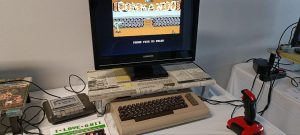
The C16’s graphics capabilities, while modest compared to the C64, were sufficient to convey the excitement of a Formula 1 race. In combination with a joystick, Formula 1 provided satisfying and challenging gameplay, demonstrating that even simpler 8-bit computers could deliver engaging entertainment experiences. Critics of the Commodore 16 noted its limitations: the absence of true hardware sprites, the simpler sound capabilities, and the relatively small library compared to the C64. Yet these limitations did not prevent the machine from finding a niche among beginner users. Parents looking for a safe, low-cost introduction to computing often selected the C16, while young gamers discovered a wealth of entertaining programs, including Formula 1 racing game that tested reflexes and concentration. The combination of learning potential and engaging gameplay was particularly appealing in educational settings, where the machine could be used to teach logic, mathematics, and even programming fundamentals.
Although the Commodore 16 was eventually overshadowed by the C64 and discontinued in the late 1980s, its contribution to home computing remains noteworthy. It introduced a generation of users to programming, gaming, and digital creativity at an affordable price point. Formula 1 games on the C16 exemplify this dual legacy: they were entertaining, skill-building, and technically impressive given the platform’s limitations. For many players, the thrill of racing along colourful circuits, avoiding rival cars, and chasing the fastest lap times was their first taste of what home computers could offer.
Ultimately, the Commodore 16 and its Formula 1 racing game illustrate a particular moment in the history of 8-bit computing: a period when accessibility, affordability, and creative software design intersected. Even without the advanced hardware of more expensive machines, the C16 delivered meaningful experiences, combining education and entertainment in a way that was uniquely suited to the mid-1980s home computer landscape. Its legacy, though modest, is preserved in the memories of those who learned, played, and raced their way through its digital circuits, discovering the joys of computing along the way.










 English (UK)
  Suomi
Suomi  Español