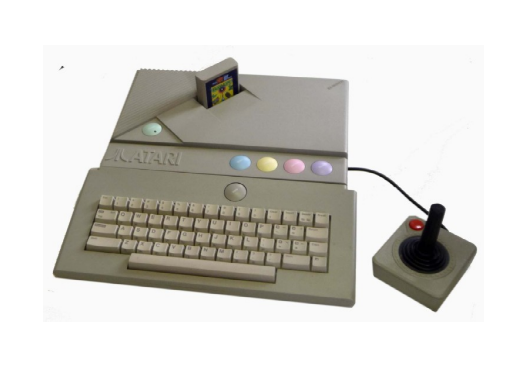
The last 8-bit endeavor from Atari
By the mid-1980s, the home-computer and videogame-console markets were undergoing significant change. The dramatic crash of the videogame market in the United States beginning in 1983 underscored how saturated the market had become and how difficult it was for incumbents to revive growth. Meanwhile, the 8-bit home-computer market (machines like the Atari 800XL, the Commodore 64, and others) was seeing both its heyday and the first signs of transition to next-generation systems. Into this environment stepped Atari (via its incarnation as Atari Corporation after the company restructure under Jack Tramiel) with the XEGS in 1987. The goal was to blend the worlds of videogame console and home computer, offering compatibility with the existing Atari 8-bit computer line while presenting a more console-oriented form for families and gamers.
The Atari XEGS (Atari XE Video Game System) was essentially a redesign of the Atari 65XE home computer (part of the XE family) packaged as a games console with the optional addition of a keyboard to convert it into a fully capable Atari 8-bit computer. It was released in 1987.The machine used a MOS 6502C (often 1.79 MHz NTSC or 1.77 MHz PAL) CPU, 64 KB of RAM (onboard) and ran the familiar Atari 8-bit architecture: chips like ANTIC and GTIA for graphics, POKEY for sound. For media, it used cartridge format and also accepted most of the older Atari 8-bit software and hardware — hence it could in theory serve as both console and computer. One key packaging variant was the “basic” set (console + joystick) and the “deluxe” set (console + joystick + detachable full-keyboard + XG-1 light-gun).
Sales and production figures
Exact global sales figures for the XEGS are somewhat elusive and inconsistent. One credible data point is that Atari sold approximately 100,000 XE Game Systems during the Christmas 1987 launch period, a figure described as “every unit produced during its launch window”. Some other sources note that overall support and new game releases tapered off after 1988, and that the 8-bit line (including the XEGS) was discontinued by Atari by early 1992.One source suggests that the XEGS did not feature at all in Atari’s annual reports after 1990, implying limited ongoing production. Therefore, while the 100,000 units number gives a snapshot for the launch, the total lifetime sales figure may have been somewhat higher but still modest compared with major console players of the time.
What the press and magazines wrote, positives and negatives
Contemporary and retrospective commentary on the XEGS emphasised a mix of promise and limitations. On the positive side, reviewers appreciated that the XEGS offered a dual-mode device: for users who wanted a console (plug in, joystick, game) it served that, while for those willing to attach the keyboard it became a full home computer with the rich Atari 8-bit software and peripherals. For example, one reviewer called the combination “a brilliant idea” for users who “didn’t have the foggiest idea what to do with a computer … [but] would have no compunction about buying a great video-game system”. In hardware terms, the leveraging of the existing 8-bit Atari architecture meant that compatibility (in many cases) with prior software/hardware was possible, and the detachable keyboard allowed a low-entry price for console buyers.
On the negative side, the press and analysts were critical of several aspects. Despite claims of compatibility, not all older Atari 8-bit cartridges and peripherals ran 100% smoothly on the XEGS — some games required translation or did not run as expected. Some are full-disk games that take anywhere from 1-4 disks … the end result is that games like ‘Astro Chase’ … won’t run on an XEGS system.” The hardware itself was already somewhat dated by launch: the architecture was essentially mid-early 1980s technology being pushed in 1987. The software library and developer support were weak compared to major competitors — few new flagship games were developed specifically for the XEGS. One source notes that after 1988 there were virtually no new releases. Marketing seemed under-whelming and the console/computer duality may have generated confusion in the market: Was this a console for games, or a computer for hobbyists? Neither message was pushed strongly enough to differentiate. In console form the XEGS lacked the cachet and ecosystem of leading rivals such as the Nintendo Entertainment System (NES). Some hardware aspects such as the light-gun (XG-1) were judged sub-par in accuracy. Thus, while the XEGS held conceptual appeal, execution and market timing limited its impact.
Atari XEGS – the reasons to get one 1980’s
As a plug-in console with joystick, for families seeking an affordable gaming system with some pedigree (Atari brand) and a library of immediately playable cartridges. As a “starter computer” for households where the idea of a keyboard and programming hobby appealed, but full computer systems (dedicated home computers) seemed more expensive or complex. Because the XEGS could remain a console but later be expanded by adding the keyboard, it offered flexibility. For users already owning Atari 8-bit software/hardware, the XEGS offered backward compatibility and a convenient way to reuse existing cartridges, peripherals and cassette/disk drives. For educational purposes: the full computer mode (with keyboard) provided access to programming (Atari BASIC Revision C) and the wide range of educational software developed for the Atari 8-bit line. In markets where new console options were expensive and older 8-bit machines were still viable, the XEGS might have offered good value.
The lifespan of the XEGS was relatively short. Although released in 1987, support and production of the Atari 8-bit line (including the XEGS) was officially discontinued by December 1991. After that date, the XEGS was no longer actively supported and became effectively obsolete in the face of 16-bit machines and emerging console generations. One retrospective source notes that the system “did worse than the Atari 7800 … and was yet another instance of Atari failing to save itself from Nintendo’s increasingly domineering presence.” In effect, the XEGS occupies a transitional niche: a late 8-bit Atari product that tried to straddle the console-and-computer boundary but ultimately did not secure a large market share or long lifespan.
Competition and market context
When the XEGS launched in 1987, the competitive environment was formidable. On the console side, Nintendo’s NES dominated the market in many territories. On the computer side, 16-bit home computers (e.g., the Atari ST line, the Commodore Amiga) were beginning their rise. The Atari XEGS had to compete not only with dedicated consoles offering strong marketing and fresh libraries, but also with home computers offering more advanced capabilities for programming, graphics and higher memory. In addition, the fact that the XEGS was architecturally tied to older 8-bit technology meant it lacked the “wow factor” of newer machines and thus struggled to differentiate. Thus, the XEGS’s competitive disadvantage stemmed from being both too late to the console race and too modest compared to emerging computers.
Legacy
Though the Atari XEGS was not a major success, it remains of interest to retro-computing and retro-gaming enthusiasts. It represents a “bridge” model — a home console built from a home computer architecture and intended for both gaming and computing. The fact that it is compatible with the wider Atari 8-bit ecosystem gives it a broad software base for hobbyists. For many collectors, the XEGS (especially in its deluxe keyboard + light-gun bundle) is a notable piece of Atari history and a symbol of the company’s efforts to reposition itself in the late 1980s. While the machine did not turn the tide for Atari, it is remembered as a bold if flawed attempt to straddle multiple market segments at once.
The Atari XE Game System (XEGS) was introduced in 1987 as an attempt by Atari Corporation to merge the worlds of console gaming and home computing, leveraging its existing 8-bit computer architecture (the XE line) in a new form factor. While it offered flexibility, compatibility and reasonable hardware for the era, it suffered from outdated technology, weak software support, and fierce competition from both dedicated consoles and emerging home computers. Although launch-sales of around 100,000 units indicate some initial interest, the limited lifespan (discontinuation by ~1991) and modest impact on the market underscore its niche status. For users seeking an affordable console or introduction to computing in the late 1980s, the XEGS may have made sense—but in the evolving landscape of videogames and computers its capabilities were already somewhat behind the curve. Nonetheless, in retrospect it serves as an interesting footnote in Atari’s history and the creative cross-pollination of console and computer design.
Popular games
Here are some games presented that were popular on Atari XE.
Boulder Dash
Bug Hunt (light gun)
Dig Dug
Donkey Kong
Flight Simulator II
Frogger
Pac-Man
Pitfall!
River Raid
Zaxxon









 Español
  English (UK)
  Suomi
Suomi