
Japan’s Modular Home Computing Legacy
In the vibrant home computer scene of the 1980s, Japan sought to unify the fragmented market with a standardized platform. This led to the creation of the MSX standard, a collaborative specification adopted by many manufacturers, including Toshiba, Sony, Panasonic, and Yamaha. Among these, Toshiba’s MSX computers played a notable role, especially in Japan and parts of Europe. One of the hallmark games to grace these machines was Road Fighter, a fast-paced racing title from Konami that showcased the MSX’s gaming capabilities. Together, Toshiba’s hardware and Konami’s software highlight the MSX ecosystem’s balance of modularity and entertainment.
MSX: Japan’s Unified Home Computing Vision
Launched in 1983, the MSX standard was designed by Microsoft Japan and ASCII Corporation. The goal was simple: unify home computing hardware under a common set of specifications, ensuring software compatibility across machines from various manufacturers. MSX (short for “Machines with Software eXchangeability”) featured:
- Zilog Z80A CPU at 3.58 MHz.
- 16KB to 64KB RAM, depending on model.
- Standardized Video Display Processor (VDP)—the Texas Instruments TMS9918 or derivatives.
- Sound via General Instrument AY-3-8910 chip.
- Cartridge slots for games and software.
- Optional tape or floppy drive storage.
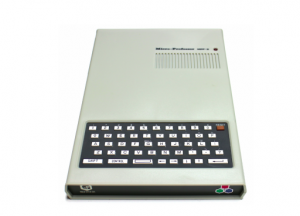
Unlike computers in U.S and Europe with proprietary architectures (like the Commodore 64 or ZX Spectrum), MSX ensured that any game or program would work across any MSX-compatible machine, regardless of brand. Toshiba, already a major electronics firm in Japan, was one of the early adopters of the MSX standard. While companies like Sony and Panasonic gained more global fame in the MSX world, Toshiba contributed several reliable, affordable machines. Toshiba’s machines were particularly popular in Japan, but also sold in select European markets like Spain and Italy. While the MSX was used for productivity tasks like word processing and programming in MSX BASIC, its real strength lay in gaming. Dozens of Japanese developers, including Konami, Capcom, and Hudson Soft, released high-quality games for the platform. One of the standout arcade-style games on Toshiba MSX computers was Road Fighter, developed by Konami. In Japan, Toshiba’s MSX computers were viewed as reliable, mid-range options for families, students, and hobbyists. While not as aggressively marketed as Sony’s or Panasonic’s MSX machines, Toshiba models gained respect for their sturdy build quality and compatibility with the broad MSX software library. However, in the competitive Western markets, MSX adoption was limited due to the dominance of Sinclair, Commodore, and Amstrad. Toshiba’s MSX computers, while not as dominant as some of their rivals, contributed to one of the most innovative standardization attempts in home computing history. Combined with iconic games like Road Fighter, Toshiba’s MSX machines offered both educational and entertainment value to a generation of users, particularly in Japan. Though the MSX dream of a unified global home computer standard eventually faded, its influence endures, and Toshiba’s contributions to the MSX ecosystem remain part of its rich legacy.
MSX Racing Legends: The Story of Road Fighter
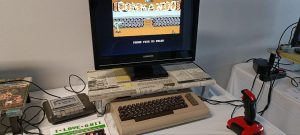
Road Fighter is a top-down racing game in which the player controls a sports car navigating a series of increasingly difficult courses. The objective is simple: reach the finish line while avoiding collisions with other vehicles and obstacles, managing speed, and collecting bonus points along the way. On MSX systems, the game demonstrated impressive use of the Z80 CPU, limited memory, and the TMS9918 VDP graphics chip, rendering smooth scrolling tracks and colorful cars despite the platform’s 8-bit constraints. The challenge of the game lay in reflexes, timing, and strategic lane changes, making each course both exciting and skill-demanding.
The MSX hardware contributed to Road Fighter’s appeal. Its bitmap-based graphics allowed developers to create a clear sense of motion, while the system’s color palette provided distinct vehicle types, road markings, and obstacles. Joystick support made control intuitive and responsive, essential for dodging oncoming traffic and maintaining speed. The sound capabilities, though modest, added engine noises and collision effects that enhanced the immersive feel of racing. In homes across Europe, including Finland, Road Fighter became a beloved title, demonstrating that MSX computers were capable of delivering engaging arcade-like experiences even without dedicated gaming hardware.
Road Fighter also illustrated the versatility of the MSX standard. Beyond gaming, MSX computers supported programming in BASIC, educational software, and productivity applications, making them valuable tools for learning as well as entertainment. In Finland, hobbyist clubs and schools often highlighted games like Road Fighter as examples of how computing could be both fun and instructive. Players developed reflexes, spatial awareness, and decision-making skills, while also gaining familiarity with the hardware and software ecosystem of the MSX platform.
Critics at the time praised Road Fighter for its smooth gameplay, intuitive controls, and addictive challenge, while also noting that MSX limitations, such as screen resolution and sound, prevented it from fully replicating arcade graphics. Nevertheless, the game’s design made clever use of the hardware, prioritizing playability and engagement over technical complexity. This approach reflected a broader philosophy in MSX software: maximize the user experience within practical constraints, making games accessible to a wide audience without sacrificing fun.
In retrospect, Road Fighter on MSX exemplifies the strengths of early home computing. It combined simplicity with skill-based challenge, providing a satisfying gameplay loop that kept players returning to improve their performance. The game’s design also highlighted the MSX’s potential as a platform capable of supporting both entertainment and education. For a generation of users, Road Fighter was more than a racing game: it was an introduction to timing, strategy, and digital interaction, all framed within the accessible and uniform environment that the MSX standard offered.
Ultimately, Road Fighter and the MSX platform together represent a moment in computing history when accessible hardware, clever programming, and engaging gameplay converged. The game captured the thrill of speed, the tension of avoiding obstacles, and the satisfaction of mastering increasingly difficult tracks, demonstrating that even 8-bit home computers could deliver meaningful and memorable entertainment. For players in the 1980s, Road Fighter was not just a game — it was a glimpse into the possibilities of the emerging digital world.








 English (UK)
  Suomi
Suomi  Español