
Leading the MSX Revolution:
The Story of the Spectravideo SVI-728
In the early 1980s, the home computer revolution was sweeping across the globe. Japan had the MSX standard, the United States had Commodore and Apple, and Europe was embracing a variety of homegrown machines. One of the less-known but technically interesting participants in this era was Spectravideo, an American company that combined ambition with innovation to produce the SVI-728, a home computer released in 1984. While it never achieved the fame of a Commodore 64 or ZX Spectrum, the SVI-728 represents a fascinating chapter in 8-bit computing and found a modest audience even in countries like Finland.
Spectravideo had its roots in peripherals and computer accessories but quickly moved into full system design. The SVI-728 was the follow-up to their earlier SVI-318 and SVI-328 models and conformed to the MSX standard, which was a key selling point. Being MSX-compatible meant that the SVI-728 could run a broad library of software and games, an attractive feature for buyers in smaller markets where software availability was otherwise limited. In the early 1980s, the MSX standard promised compatibility and a certain global uniformity: a game developed in Japan could, in theory, run on a Finnish SVI-728 just as it would on a Spectravideo in the United States.

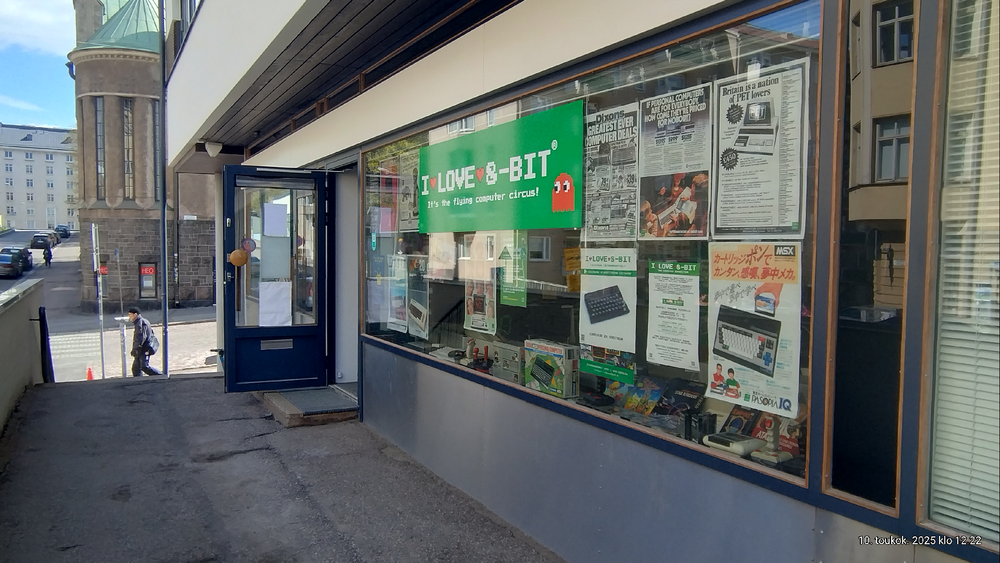
Spectravideo SVI-728 in operation at the I love 8-bit® exbitition 2023
In the early 1980s, the home computer revolution was sweeping across the globe. Japan had the MSX standard, the United States had Commodore and Apple, and Europe was embracing a variety of homegrown machines. One of the less-known but technically interesting participants in this era was Spectravideo, an American company that combined ambition with innovation to produce the SVI-728, a home computer released in 1984. While it never achieved the fame of a Commodore 64 or ZX Spectrum, the SVI-728 represents a fascinating chapter in 8-bit computing and found a modest audience even in countries like Finland.
Spectravideo had its roots in peripherals and computer accessories but quickly moved into full system design. The SVI-728 was the follow-up to their earlier SVI-318 and SVI-328 models and conformed to the MSX standard, which was a key selling point. Being MSX-compatible meant that the SVI-728 could run a broad library of software and games, an attractive feature for buyers in smaller markets where software availability was otherwise limited. In the early 1980s, the MSX standard promised compatibility and a certain global uniformity: a game developed in Japan could, in theory, run on a Finnish SVI-728 just as it would on a Spectravideo in the United States.
Technically, the SVI-728 was a capable machine. It featured a Zilog Z80A processor at 3.58 MHz and 64 KB of RAM, which allowed it to handle most home and educational programs of the era. Graphics were handled by a TMS9918 video processor, capable of displaying 16 colors and up to 32 sprites on screen, while sound came from the AY-3-8910 chip, providing three channels of tone and one for noise. This made the system suitable not only for games but also for basic music composition and educational software. Its built-in MSX BASIC interpreter allowed hobbyists and young programmers to write their own programs immediately after switching on the machine, reflecting the era’s spirit of experimentation and learning.
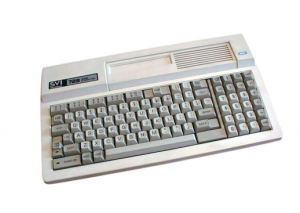
Design-wise, the SVI-728 was compact and functional, featuring a full-sized keyboard and cartridge slot. Unlike some of the cheaper rubber-keyboard systems, it was built with quality in mind, though it lacked the flashy styling that characterized some of its competitors. Expansion ports allowed connection to printers, disk drives, and joysticks, making it versatile for both home and educational use. In Finland, where computers were often seen as tools for both play and study, the SVI-728 found a niche. Finnish computer magazines of the mid-1980s occasionally covered the machine, noting its solid design and compatibility with MSX software, which allowed Finnish users access to a library of educational titles and games that might otherwise have been unavailable locally.
Despite its technical strengths, the SVI-728 faced significant challenges. The MSX standard was strong in Japan and parts of Europe, but in the United States, Commodore and Atari dominated the market. In Finland, the home computer scene in 1984–1985 was dominated by machines such as the Commodore 64, Sinclair ZX Spectrum, and later Amstrad CPC models. The SVI-728’s MSX compatibility gave it a technical advantage, but software availability and local retail support were limited, making it a harder sell to families and hobbyists. For enthusiasts and collectors, however, the SVI-728 offered a robust MSX-compatible platform with a clear design and respectable hardware. In practice, the buyers who acquired the SVI-728 often appreciated it for educational and hobbyist purposes. Schools and computer clubs could use its BASIC environment to teach programming, while children and teenagers enjoyed games like Knightmare, Penguin Adventure, and other MSX titles. Its audio and graphics capabilities allowed for creative projects, including simple music compositions and sprite-based animations, bridging the gap between entertainment and learning. For many users, the SVI-728 represented a “serious” computer in a small, versatile package, offering functionality that felt sophisticated compared to budget alternatives.
The SVI-728’s commercial lifespan was relatively short. Spectravideo continued producing and supporting MSX-compatible machines through the mid-1980s, but it could not compete with the volume sales of Commodore or the marketing power of Nintendo in the gaming sector. Production gradually ceased toward the late 1980s as newer MSX2 machines and other 16-bit computers began to dominate the market. Yet even decades later, the SVI-728 remains a favorite among retro-computing enthusiasts, especially in Europe. Collectors in Finland and neighboring countries often seek out the machine for its solid build, compatibility, and the nostalgia it evokes for an era when home computing was new, experimental, and exciting. Ultimately, the Spectravideo SVI-728 exemplifies a particular moment in computing history: a time when the MSX standard promised global compatibility, when computers were both tools and toys, and when even smaller players could make technically capable machines with a lasting legacy. In Finland, as elsewhere, it served as a bridge between education, gaming, and early programming exploration. While it never reached the fame of its contemporaries, it remains a symbol of the creativity, ambition, and optimism of the mid-1980s home-computer era. For those who experienced it, the SVI-728 was more than just hardware; it was an introduction to a world of digital possibility.









 Español
  English (UK)
  Suomi
Suomi